

Casino Game Development Costs in 2026: Complete Guide
The online gambling industry continues to expand rapidly as mobile gaming, secure payment solutions, and regulated markets grow worldwide. According to Grand View Research, the global online gambling market is projected to exceed $153 billion by 2030, reflecting sustained demand for online casino platforms and digital slot games.
For casino operators, gaming startups, and investors entering the iGaming sector, having a clear understanding of casino game development costs is essential. Budgets can vary significantly based on game type, production quality, technology stack, and the structure of the development team.
This guide outlines how much casino games typically cost to develop in 2026, the main factors that influence those budgets, and whether outsourcing casino game development is more efficient than building an in-house team.
In casino game development, budgets rarely grow because of one big decision — they expand through dozens of small ones. Teams at Whimsy Games deal with this dynamic across full-cycle projects, where even minor scope changes can shift both timelines and total cost.
What Is Casino Game Development?
Casino game development is the process of designing, building, testing, and launching digital gambling games for online casino platforms.
These products include slot machines, blackjack, roulette, poker, crash games, and other betting experiences. Unlike traditional video games, casino titles must comply with strict regulatory and fairness requirements. They rely on certified random number generators (RNGs), carefully balanced payout systems, and external compliance verification prior to launch.
Because of these requirements, casino game production brings together multiple disciplines, including:
- Game design
- Mathematical modeling
- Art and animation production
- Software engineering
- Integration with casino platforms and back-office systems
In practice, casino game development is the end-to-end process of designing, building, and deploying digital gambling games – such as slots, blackjack, or roulette – that run on online casino platforms and comply with regulated gaming standards.
- Casino slot game development cost refers to the total budget required to create a digital slot game, including game design, math modeling, art and animation, programming, testing, and regulatory certification.
- Casino game outsourcing is the practice of hiring an external game development studio to design or produce casino games, instead of building and maintaining a full in-house development team.
How Much Does It Cost to Develop a Casino Slot Game in 2026?
Slot games represent the largest segment of online casino content, and their development cost is driven primarily by gameplay complexity and production quality.
- Basic slot games with simple mechanics and limited animation typically cost $10,000 to $25,000 to develop. These titles usually feature standard reel mechanics, fixed paylines, and straightforward visual assets.
- Mid-range slot games, which incorporate themed artwork, animated symbols, and one or more bonus features, generally fall in the $30,000 to $80,000 range.
- Advanced or premium slot titles with cinematic animations, complex bonus systems, and progressive jackpots can require $150,000 to $500,000 or more, particularly when extensive art production and multi-platform integrations are involved.
Because slot games rely heavily on visual presentation and player engagement, art and animation often represent a substantial portion of the overall development budget.
As Denys Kliuch, CEO of Whimsy Games, explains:
“The biggest misconception is that slot development cost is driven only by features. In reality, visual production and polish often define up to 50% of the total budget, especially in competitive casino markets.”
What Factors Affect the Cost of Casino Game Development?
Several production components influence the total cost of building a casino game.
1. Game Complexity
One of the most important cost drivers is gameplay complexity. A simple slot with fixed paylines demands relatively modest engineering effort, while modern casino games often include advanced mechanics such as:
- Cascading reels
- Bonus mini-games
- Expanding or sticky wilds
- Multi-level jackpot systems
Each additional feature adds design, development, and testing time, increasing the overall budget.
2. Visual and Audio Production
Casino games rely on strong visual themes and appealing presentation to attract and retain players. This typically requires a large volume of art and animation, including:
- Reel symbols and icon sets
- Themed backgrounds and environments
- User interface elements
- Visual effects and transitions
High-quality illustration, animation, and sound design enhance engagement but also increase production costs.
3. Game Mathematics and Balance
Game mathematics is a distinctive aspect of casino game development. Designers and mathematicians must define:
- Return-to-player (RTP) values
- Volatility and variance profiles
- Hit frequency and payout distributions
These systems must strike a balance between engaging gameplay, operator profitability, and compliance with regional gambling regulations. Creating and validating math models requires specialized expertise and additional development time.
From a production perspective, Whimsy Games frequently works with both startups and established operators to optimize these cost drivers early in development. In many cases, adjusting scope, reusing proven frameworks, or prioritizing MVP features allows teams to significantly reduce time-to-market without compromising core gameplay quality.
4. Platform Integrations
Many casino games need to integrate with third-party platforms, including:
- iGaming aggregators
- Operator back offices
- Wallet and payment systems
- Bonus and promotion engines
Each integration point can add complexity and extend timelines, particularly when supporting multiple operators and jurisdictions.
5. Regulatory Certification and Compliance
Finally, regulatory certification also affects cost. Games typically require external testing and validation of RNG systems, payout tables, and overall fairness before they can be launched on regulated platforms.
Certification with multiple testing labs and jurisdictions can add both direct fees and additional development iterations.
Is It Cheaper to Outsource Casino Game Development or Build In-House?
Companies entering the iGaming space generally face a strategic decision: build an internal team or outsource development to specialist studios.
According to Denys Kliuch, CEO of Whimsy Games:
“Outsourcing is no longer just about reducing costs. For many operators, it’s about accessing specialized expertise in compliance, game math, and production pipelines that would take years to build internally.”
In-House Development
Building an internal team offers full control over technology, processes, and intellectual property. However, it also requires substantial upfront and ongoing investment in:
- Salaries and benefits
- Office and infrastructure (or remote tooling and security)
- Recruitment and onboarding
- Management and production overhead
Even a relatively lean in-house team can generate high fixed monthly costs.
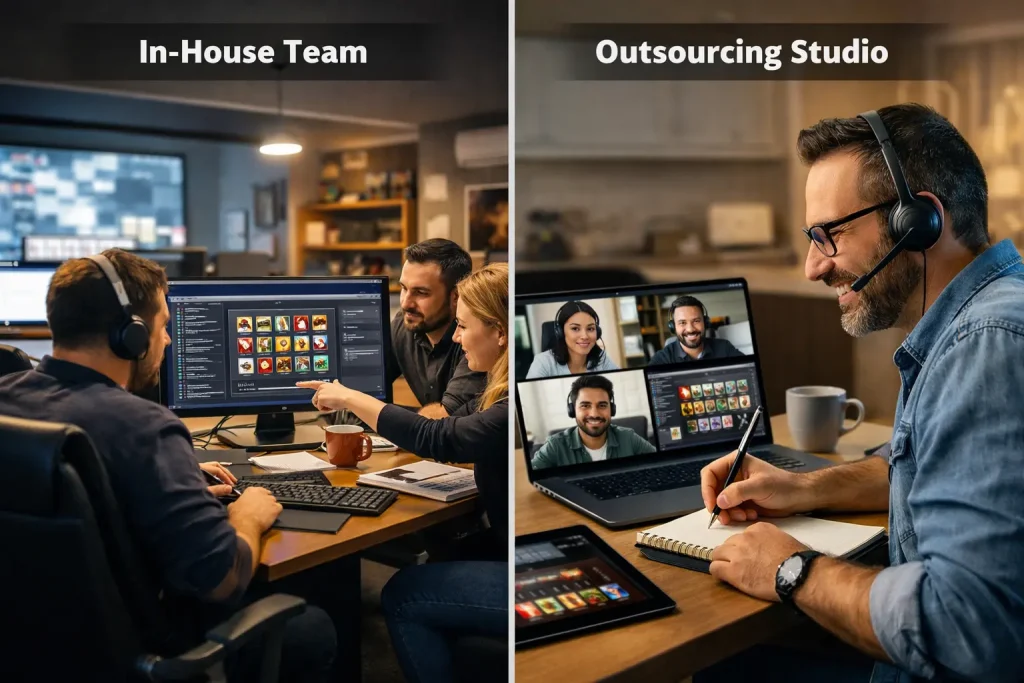
Outsourcing to Specialized Studios
Outsourcing casino game development enables companies to collaborate with experienced studios that already have:
- Established production pipelines
- Proven technology stacks
- Domain expertise in math, compliance, and art production
This model often reduces operational overhead and accelerates time-to-market, particularly for organizations new to casino content.
Typical development rates vary widely by region:
- United States: $150-$250 per hour
- Western Europe: $120-$200 per hour
- Eastern Europe: $80-$140 per hour
- Asia: $25-$70 per hour
These regional rate differences are a key reason many casino operators and content providers choose to outsource development to experienced studios.
How Long Does Casino Game Development Take?
The development timeline for a casino game depends on project scope, complexity, and the size and experience of the team.
Most slot projects follow a similar lifecycle:
- Concept and pre-production – Theme definition, market research, and high-level feature design.
- Mathematical modeling – RTP, volatility, and payout structures are defined and simulated.
- Art and UX production – Visual direction, symbol sets, UI, animations, and audio are created.
- Engineering and implementation – Core game mechanics, client logic, and platform integrations are developed.
- Testing and quality assurance – Functional, performance, and device compatibility testing.
- Certification and launch – Submission to test labs and deployment to casino platforms.
For many projects, the end-to-end development cycle ranges from three to six months. Larger, content-rich, or technically complex games can require longer production windows.
Casino Game Development Cost Comparison
The table below summarizes typical cost ranges for casino slot game development in 2026, based on production scope and feature complexity.
| Game Type | Typical Features | Development Time | Estimated Cost |
| Basic slot game | Standard reels, fixed paylines, minimal animation | 1-2 months | $10,000 – $25,000 |
| Mid-range slot game | Themed visuals, animated symbols, and one or more bonus rounds | 2-4 months | $30,000 – $80,000 |
| Advanced slot game | Multiple bonus systems, advanced animation, and dynamic gameplay | 3-5 months | $80,000 – $150,000 |
| Premium slot game | Cinematic visuals, progressive jackpots, complex feature sets | 4-6 months | $150,000 – $500,000+ |
These ranges reflect typical production budgets used by many online casino operators and game studios in 2026. Actual costs will depend on the specific requirements, technology stack, and regions involved.