
Top Slot Game Development Companies in 2026: Suppliers, Custom Studios and Art Partners
Slots drive the online casino market. In 2024, the iSlots segment held the largest share of online casino revenue, at more than 65%. The broader market is still growing fast. Online gambling was valued at $88.0 billion in 2025 and is projected to reach $97.7 billion in 2026, then $202.8 billion by 2033.
Such a demand has created a crowded supplier market where very different companies use similar language. Slot and casino game development companies appear in the same search results, but they don’t all solve the same problem. A licensed content supplier, a game aggregator, a custom studio, and an art house each serve a different need. Sending the same brief to all of them can waste weeks.
Below, you’ll find 15 top slot game development companies grouped by the job they do, with founding year, location, and service model for each.
Key takeaways
- Slots generate more than 65% of online casino revenue, so supplier choice is a major roadmap decision for operators.
- The top slot game development companies here include Whimsy Games for custom builds where the client keeps the code and IP; Playtech for a 1,000+ title catalogue and its own platform; Games Global for 1,300+ proprietary games across 40 studios; Pragmatic Play for fast releases through a single API; Play’n GO for recognised franchises live in 35+ jurisdictions; and Thunderkick for a slots-only catalogue licensed by the MGA and the UK Gambling Commission.
- Slot game companies fall into 4 groups: content suppliers that own their catalogs, aggregators that distribute games, custom studios that build to your brief, and art studios that produce visuals only.
- Ownership has also shifted. Microgaming sold its distribution business and online games portfolio to Games Global in May 2022, while Evolution now runs NetEnt, Red Tiger, Big Time Gaming, and Nolimit City as its RNG brands.
- Compliance is now part of game design. In Great Britain, the £5-per-spin cap for players aged 25 and over takes effect on 9 April 2025. The £2 cap for players aged 18 to 24 applies from 21 May 2025.
- Licensing ready-made content is the fastest way to fill a live lobby. If you want to own the maths model, theme, and IP, you need a custom build.
What do slot game development companies do?
A slot game development company designs and builds slot games. That work can include the maths model that sets RTP and volatility, reel logic, bonus mechanics, art, animation, the HTML5 client, server integration, and the documentation needed for independent lab certification.
Some companies own finished titles and license them to operators. Others build to a client’s brief and hand over the code and IP.
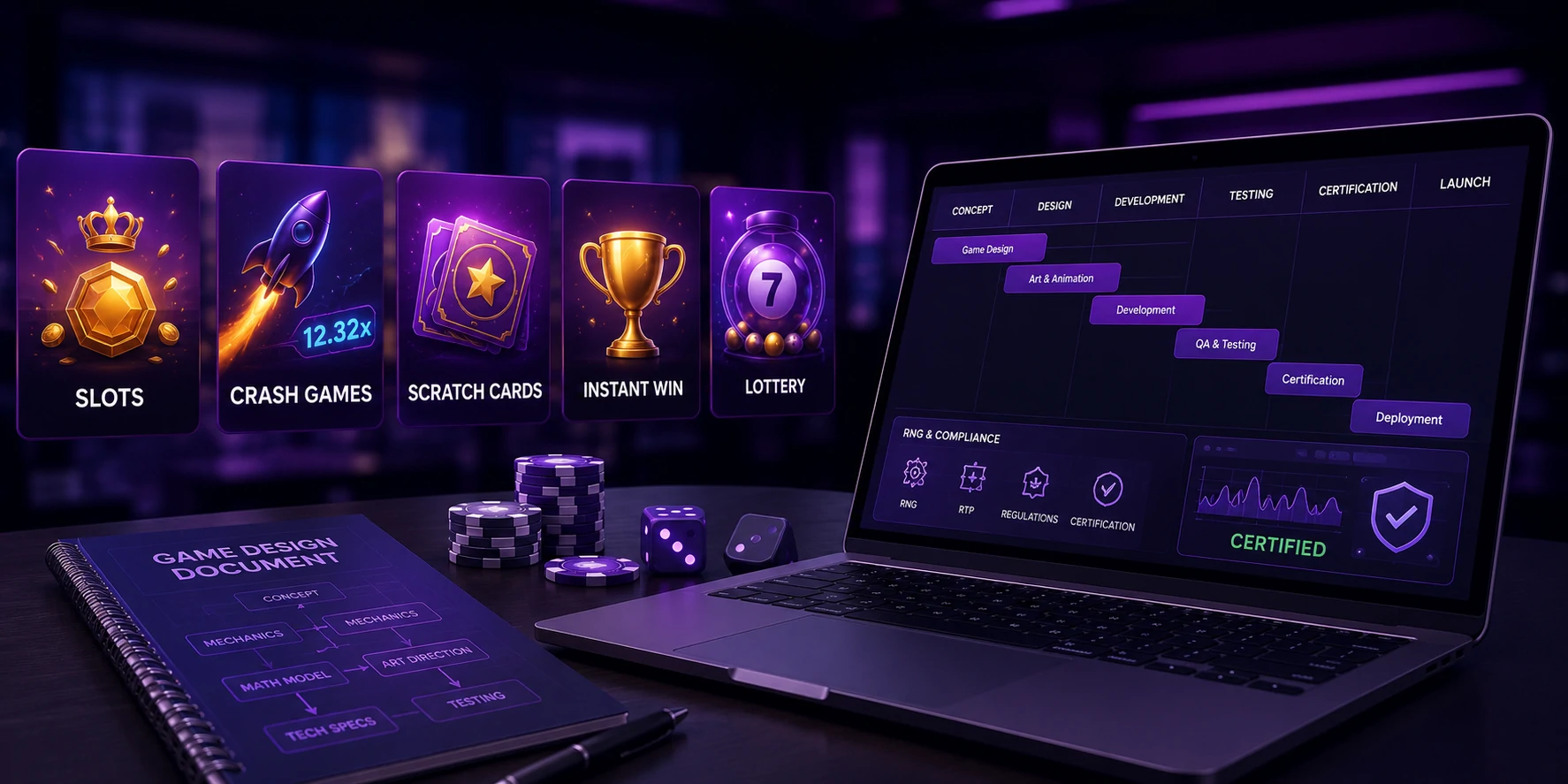
On the contrary, casino game development companies cover a broader range of products. Alongside slots, they may develop table games, crash games, scratch cards, bingo, and live-dealer products. This distinction matters when you build a shortlist. A studio that releases one video slot a month works very differently from a supplier that manages a 1,000-title catalog across several casino verticals.

Comparison of the 15 top slot and casino game development companies
The 15 top slot game development companies below are grouped by service model; they’re not ranked. A licensed content supplier and a slot art studio do different jobs, so scoring them against each other wouldn’t be useful. Use the “best fit for” column to narrow the list by company type, then read the profiles for licenses, catalog size, and client work.
| Company | Type | Founded | Based | Best fit for |
| Whimsy Games | Custom studio and art partner | 2018 | UK and Ukraine | Bespoke slots, art and animation you own outright |
| GammaStack | Custom platform and game studio | 2012 | India, Latvia, Malta, US | Turnkey or bespoke platforms with code ownership |
| BR Softech | Custom development company | 2010 | Jaipur, India | Cost-sensitive custom builds across casino verticals |
| Playtech | Content supplier and platform | 1999 | Isle of Man | Operators want content plus a platform from one regulated supplier |
| Games Global | Content supplier and distributor | 2021 | Isle of Man | Large licensed catalog with a jackpot network |
| Pragmatic Play | Multi-vertical content supplier | 2015 | Gibraltar | High release cadence through a single API |
| Play’n GO | Content supplier | 1997 | Växjö, Sweden | Recognized slot franchises in regulated markets |
| Evolution (RNG brands) | Content supplier group | 2006 | Stockholm | Access to NetEnt, Red Tiger, BTG, and Nolimit City catalogs |
| Yggdrasil | Content supplier and framework | 2013 | Malta | Distinctive mechanics plus a partner-studio program |
| Thunderkick | Slots-only studio | 2012 | Stockholm | Small, visually distinct catalog |
| Mobilots | Mobile-first slots studio | 2015 | Mosta, Malta | Lightweight HTML5 content for mobile lobbies |
| Slotegrator | Aggregator and platform | 2012 | Limassol, Cyprus | One integration instead of many supplier contracts |
| SOFTSWISS | Aggregator and platform | 2009 | Malta | Large-scale aggregation with crypto and platform tooling |
| RocketBrush | Art studio | 2016 | Limassol, Cyprus | Symbols, backgrounds, and animation for an existing build |
| Three Tails | Art studio | n/a | Sofia, Bulgaria | Stylized slot illustration and animation only |
Custom slot game development companies
With a custom build, you own the output: the theme, the maths model, the art, and the code.
Whimsy Games
Among the top slot game development companies on this list, Whimsy Games is a custom studio that builds to a client’s brief. The company has more than 8 years of experience in game development and moved into iGaming in 2023, starting with reskins of existing slots for game providers and expanding into full-cycle production. Several team members bring individual iGaming experience that predates the studio’s own move into the sector. Its Clutch profile carries 25 verified reviews at an average rating of 5.0 out of 5.
Slots are Whimsy Games’ core iGaming capability, from simple mechanics to more complex feature sets. The team also develops scratch cards, lottery products, real-money backgammon, sweepstakes platforms, and games based on Plinko, dice, crash, mines, wheel, diamond, and tarot mechanics. It also handles reskins of existing titles.
Client engagements have come from the US, Malta, Belgium, the UK, Denmark, and Greece. Whimsy Games has also supported live launches in the US and EU, with projects reaching additional markets. Most delivered work is under an NDA, which is common in iGaming.
Engagements run either as project-based full-cycle delivery or as a dedicated iGaming team embedded in the client’s pipeline. Pricing starts around $20,000 to $40,000 per game and increases with complexity. Timelines range from about 3 weeks for a reskin to a month or more for a full build, depending on scope.
GammaStack
GammaStack says it was founded in 2012 and now delivers turnkey and modular platforms, sportsbook and casino systems, aggregation hubs, and bespoke enterprise products. The company started in Indore, India, as Techracers before rebranding. Today, it operates from Indore and Bengaluru in India, Riga in Latvia, Wilmington in Delaware, and St Julian’s in Malta.
Its product set is modular and branded: GammaCasino for casino platforms, GammaBet for sportsbook, GammaSlot for bespoke and ready-made slot games, and GammaLottery and GammaSweep for lottery and sweepstakes products.
GammaStack’s commercial model is its main differentiator. The company sells full code ownership with no revenue share. It reports ISO 9001:2015 and ISO/IEC 27001:2022 certification.
Published launch windows run 2 to 4 weeks for a white-label platform, 5 weeks for a turnkey solution, and 6 to 12 months or more for a custom platform, depending on customization, integrations, and license acquisition. GammaStack was also named a finalist for Platform Provider of the Year at the Global Gaming Awards EMEA 2026.
It’s a strong fit for operators who want both the platform and games from a single vendor and intend to own the stack.
BR Softech
BR Softech started as a proprietorship in Jaipur in 2010 and was incorporated as a private limited company on 30 April 2012, according to its founder’s account. Tracxn lists Nitin Kumaar Garg and Amar Pal Singh as founders, with the registered office in Jaipur, Rajasthan.
The company is ISO 9001-certified and headquartered in Jaipur, with operations in the USA, the UK, Australia, and Singapore. Its team covers HTML5, cross-platform development, Web3, blockchain, AR/VR, and slot game development.
BR Softech’s scope extends beyond slots. The company supports online casinos and sportsbooks with mobile game development, sports betting software, Web3 game development, live casino API integration, and custom casino builds for Android, iOS, Windows, and Mac. It also handles the integration of RNG into existing operator platforms.
A published Clutch case study describes a five-game casino app covering blackjack, baccarat, Texas hold’em, Omaha poker, and roulette, staffed by a 12-person team. Third-party directory listings show hourly rates of $25 to $49, with minimum project sizes of $5,000 to $10,000.
BR Softech is a good fit for cost-sensitive builds spanning several casino verticals, not just slots.
Content suppliers that license their own slots
These companies own the maths model, code, and IP. You integrate their games into your lobby and share revenue, but don’t own the titles.
Playtech
Playtech was founded in 1999 in Tartu, Estonia, by Israeli entrepreneur Teddy Sagi, together with partners from the casino, software engineering, and multimedia industries. The company is now headquartered in Douglas, Isle of Man.
It launched its first casino product in 2001 and floated on the AIM market in March 2006 at a valuation of about $950 million. Playtech now trades on the London Stock Exchange as a FTSE 250 constituent under the ticker PTEC, which gives operators access to audited reporting and board governance that private studios usually can’t offer.
Its portfolio includes more than 1,000 casino titles across slots, video poker, table games, and live dealer games. The group also holds more than 180 licenses across 40+ regulated jurisdictions. Estonia remains its main platform development center, with more than 700 specialists across Tartu and Tallinn.
Slots sit inside a broader stack that includes casino, live casino, sports betting, and platform technology for operators in 20+ countries. These products are connected through Playtech’s PAM+ single-wallet system.
In April 2025, Playtech sold Snaitech for about €2.3 billion, funding a €1.8 billion special dividend and refocusing the group on B2B. In H1 2025, B2B revenue reached €347.6 million, while US B2B revenue grew 64% year-on-year.
Choose Playtech when you want casino content and platform technology from one of the listed, heavily licensed suppliers.
Games Global
Games Global was incorporated in 2021 and is based in Douglas, Isle of Man. It was founded by former Lottomatica and IGT executive Walter Bugno and a partner, and entered the market by acquiring Microgaming’s Quickfire game engine.
That deal closed in May 2022, transferring a large back catalog of exclusive content and a customer network covering more than 900 gaming brands. Microgaming then refocused on platform systems and Betway sports betting technology. Operators still searching for new Microgaming slots are usually looking for Games Global.
Games Global works with 40 in-house and partner studios, which have produced more than 1,300 proprietary games over roughly 20 years. Slots, including progressive variants, make up most of its revenue, alongside table games, video poker, video bingo, game shows, crash games, and live casino.
Its jackpot network includes Mega Moolah and Book of Atem WowPot, pooled across casino networks. The company holds licenses from the UK Gambling Commission and the Malta Gaming Authority, while its Malta subsidiary, Prima Networks Limited, handles regulated European distribution.
Games Global also expanded in 2023 by acquiring Super Group’s non-core B2B units. Studio partners include Gameburger, Slingshot, Fortune Factory, Foxium, and Just For The Win.
Pragmatic Play
Pragmatic Play was founded in 2015 through the acquisition of TopGame Technology. It now holds licenses in markets including Ontario, the UK, Malta, Gibraltar, and Sweden, and is certified in more than 40 jurisdictions.
CEO Julian Jarvis leads the company from Gibraltar. Pragmatic Play supplies content to operator brands through a single API and has offices in Malta, Romania, Bulgaria, India, and the Philippines. Its workforce exceeds 1,000, and its catalog includes more than 500 slots, as well as live casino, crash games, scratchcards, and virtual sports.
Release cadence and distribution reach are the main reasons operators carry Pragmatic Play content. Its games are certified by BMM Testlabs and GLI, and the company builds its own stack in-house, including RNG, maths models, art, and server infrastructure.
Its Drops & Wins program is a provider-funded, cross-operator prize network. Recent recognition includes Brand of the Year at the IGA and European Software Supplier at the EGR Europe Awards in 2026.
One strategic shift matters at the shortlist stage. In June 2026, Pragmatic Play announced it was winding down sportsbook, virtual sports, and bingo to focus on slots and live casino. Flagship titles include Gates of Olympus, Sweet Bonanza, and Big Bass Bonanza.
Play’n GO
Play’n GO was founded in 1997 in Växjö, Sweden, by Joakim Dahl and Johan Törnqvist, and remains headquartered there. The company first worked as a subcontractor producing casino software for other providers. In 2004, it began creating proprietary slots.
It received its Malta Gaming Authority license in 2012, followed by Italy in 2013 and Romania in 2016. By 2007, Play’n GO had released what the industry widely credits as one of the first mobile-optimized casino slots, years before mobile became the dominant format. In 2010, it merged with Jadestone, developer of the Casino Matrix platform.
The company reports more than 400 premium titles, including Rich Wilde and the Book of Dead, delivered to regulated operators across 35+ jurisdictions. Certifications come from BMM Testlabs, GLI, and Quinel, as well as ISO 27001 for information security.
Headcount sits at around 638 as of April 2026, with offices in the UK, Malta, Hungary, and the Philippines. Franchise recognition is Play’n GO’s main commercial strength. Titles such as Book of the Dead, Reactoonz, Moon Princess, and Rise of Olympus are searched for by name, which makes them useful for acquisition campaigns.
Evolution and its RNG brands
Evolution is best known for live casino, but its slot footprint is large and often misattributed. Its RNG brands include Nolimit City, Red Tiger, NetEnt, and Big Time Gaming, with Sneaky Slots added as a new studio in September 2025.
Big Time Gaming, acquired for €450 million in 2021, invented Megaways and Bonus Buy. Few mechanics have been copied more widely. For operators, the key point is commercial: anyone negotiating separately with NetEnt and Red Tiger is still dealing with one parent company.
NetEnt’s Starburst is the group’s top-performing online slot globally. In 2025, Evolution also agreed to a deal with Gaming Arts to adapt NetEnt titles for land-based cabinets across North America, starting through its land-based partner Bluhare Studios.
NetEnt also holds one of the sector’s record jackpot payouts, €17.86 million, from Mega Fortune. In July 2025, Evolution signed an exclusive agreement with Hasbro to build online casino games around brands including Monopoly, Clue, and Battleship.
Choose Evolution when you want access to several distinct slot studio identities under one commercial relationship.
Yggdrasil
Yggdrasil was founded in 2013 by Fredrik Elmqvist, formerly CEO of NetEnt, and operates from Malta, with additional offices in Stockholm and Krakow. Early backing came from Swedish gaming group Cherry AB. In 2014, the studio shifted more clearly into video slots with Jokerizer and Winterberries, supported by its iSENSE 2.0 HTML5 framework for cross-platform delivery. By 2016, it had added the BOOST and BRAG promotional tools.
Bragg Gaming Group acquired Yggdrasil in 2022, so its commercial structure now sits inside a wider group that also includes Oryx Gaming.
The studio is licensed by 9 regulators, including Great Britain, Gibraltar, Belgium, Malta, and Sweden. As of May 2026, it employed 357 people. Yggdrasil also holds five IGA Innovator awards and created the GigaBlox and Splitz mechanics.
Its partner program is the standout feature. YGG Masters gives third-party studios access to the GATI technical framework and distribution, with more than 20 partners currently listed. Recent additions include DEGEN Studios in July 2025 and Slightly Edgy in December 2025 as the first Game in a Box pilot studio.
Yggdrasil is a strong fit for smaller studios that want a route into regulated markets before building their own licensing and distribution stack.
Thunderkick
3 former NetEnt developers founded Thunderkick in Stockholm in 2012. The studio secured MGA and UKGC licenses in 2013, its first full year of operation. It has since grown to more than 80 people, kept development in-house, and remained independent.
Its licenses are MGA/B2B/248/2013 and UKGC 041752-R-321094-007, with RNG testing by QUINEL.
Thunderkick focuses only on video slots, deliberately staying out of table games and live casino. Its release cadence is roughly one game per month, not the weekly output of higher-volume suppliers.
By May 2026, the library had reached 99 titles, led by franchises such as Esqueleto Explosivo, Pink Elephants, Midas Golden Touch, and Beat the Beast. 1429 Uncharted Seas, in the catalog since 2014, carries a published maximum RTP of 98.60%, one of the highest base-game figures available from any studio in the UK market.
Distribution is also expanding. A 2026 deal with PointsBet opened Ontario, following a 2025 agreement with Veikkaus in Finland.
Pick Thunderkick if you want a compact, visually distinctive slot catalog with strong RTP credentials, not a high-volume supplier.
Mobilots
Mobilots was founded in 2015 and is headquartered in Mosta, Malta. The studio builds HTML5 online video slots for mobile devices, with LinkedIn listing 11-50 employees. Its name combines “mobile” and “slots,” reflecting a mobile-first position that started before many larger suppliers reorganized around handset play.
The company describes a team of developers, mathematicians, sound engineers, and graphic designers working across two international offices. Its output includes mobile slots, bingo, arcade titles, video poker, and scratchcards.
The catalog sits at roughly 30 games. Mobilots uses an open architecture with a plug-and-play API for faster integration and supports multiple currencies and balance types, including cash, bonus, and loyalty. Its games offer multiple editable paytables and support more than 40 languages and currencies, including cryptocurrencies. Distribution includes platforms such as NuxGame, and the portfolio has also moved into crash-style titles.
Mobilots signed a content partnership with Vibra Gaming in December 2022.
One diligence note matters: at least one independent reviewer could not identify a licensing jurisdiction for the trade name or find it in the Malta Gaming Authority indexes. Verify license status directly before integration.
The aggregation layer
Aggregators don’t build slots. They give operators one integration path to hundreds or thousands of games.
Slotegrator
Slotegrator was founded in March 2012 and has grown to more than 300 employees. Its offices have included Kyiv and Prague, with a registered head office in Limassol, Cyprus, plus sales and support hubs in Yerevan and Latin America.
APIgrator, its game aggregation product, launched in 2014. By mid-2024, it carried around 17,000 titles from more than 100 providers.
The current offering includes more than 30,000 certified games from over 180 licensed developers. Operators can access them through a single contract and integration, which include provider portfolios and promotions. Slotegrator says the integration can be completed in a single session lasting about 24 hours.
Its turnkey casino and sportsbook packages have published launch windows of 30 to 45 days. The company also offers licensing assistance for Curaçao, Anjouan, Malta, the Isle of Man, and Kahnawake. One point to clarify in diligence: these are advisory destinations for clients, not necessarily licenses that Slotegrator holds itself.
More than 350 operators use its content or services, and the company also runs Slotegrator Academy as an educational hub for the market. Provider partners include Habanero, Amatic, Peter & Sons, Spribe, and Slotmill.
SOFTSWISS
SOFTSWISS was founded in 2009 by Ivan Montik and Dzmitry Yaikau. It started as a web design and development company, moved into iGaming in 2012, and introduced cryptocurrency payments for online casinos in 2013.
The company moved its head office to Malta in 2020, then opened development centers in Poznań in 2021, Tbilisi in 2022, and Warsaw in 2023. Today, SOFTSWISS employs more than 2,000 specialists, supports over 1,500 iGaming brands, and has experience across 25+ regulated jurisdictions.
Its Game Aggregator launched in October 2015 and now delivers 40,000+ games from 300+ verified providers through a single API. The broader product suite also includes a casino platform, sportsbook, and prediction markets platform.
The MGA-licensed entity behind the aggregator is Stable Aggregator Limited, formerly N1 Aggregator Limited. The group’s own games studio, BGaming, spun out as a standalone brand in 2018, leaving SOFTSWISS focused mainly on aggregation and platform tooling.
SOFTSWISS maintains an ISO 27001-compliant information security management system and holds GLI certifications. In January 2024, it acquired most of the South African sports betting software company Turfsport.
It’s a strong fit for operators scaling in Europe and Latin America who want platform tooling, crypto support, and large-scale content aggregation from one provider.
Slot art specialists
These studios create visuals for a game build owned by another team. They’re the right fit when the engineering is already covered, but the symbols, backgrounds, or animations need stronger art direction.
RocketBrush Studio
RocketBrush was founded in 2016 and is based in Limassol, Cyprus. The studio provides concept art, character design, environment modeling, asset production, and animation. It creates original work rather than reselling pre-made assets.
Since 2016, RocketBrush has contributed to more than 210 projects for over 128 clients. The studio also reports that more than 85% of its work comes from returning clients. Third-party roundups describe it as a focused team of around 35 specialists, with clients noting cost savings compared with in-house production.
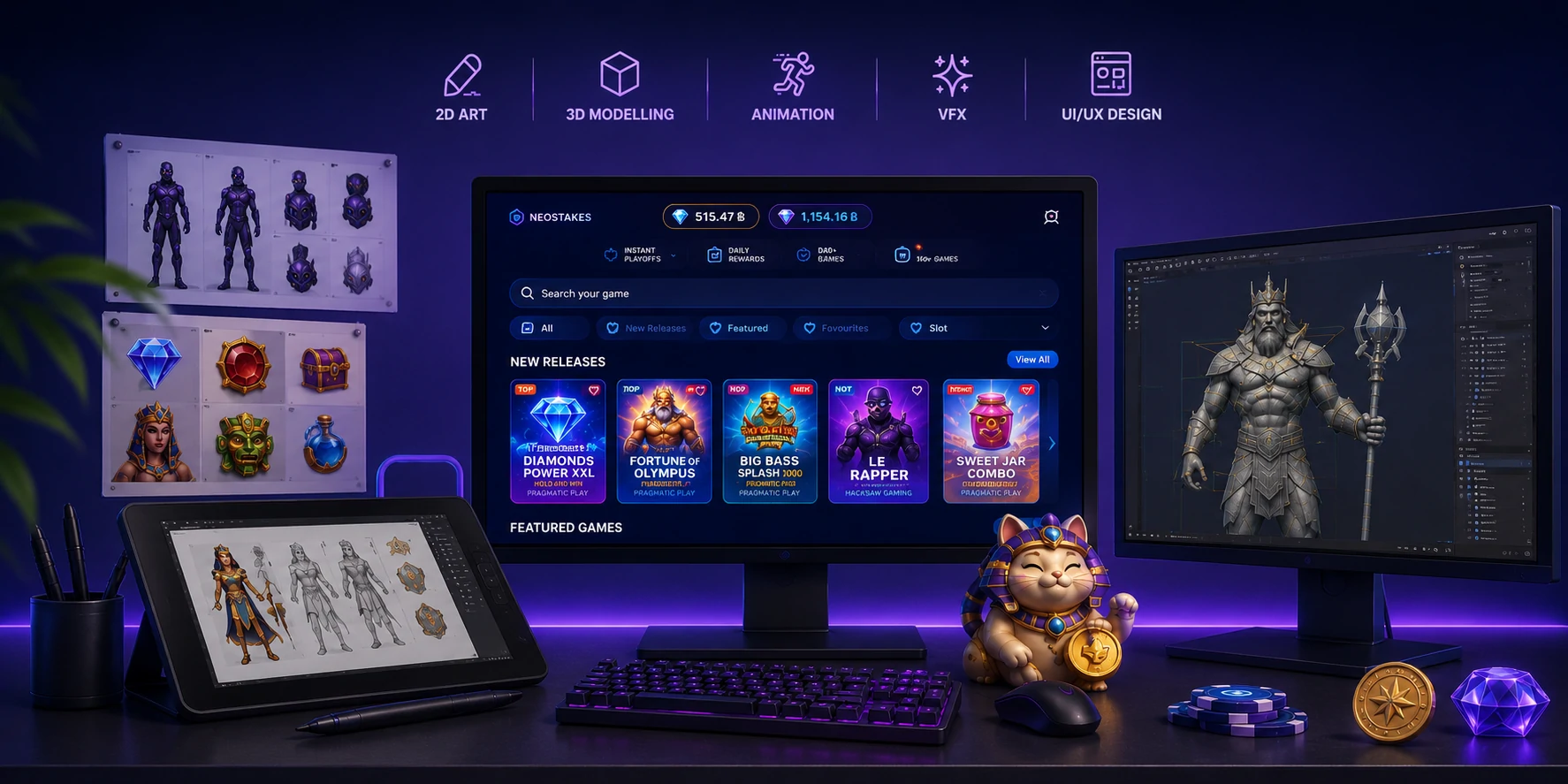
Named clients include Paradox Interactive, G5 Games, Romero Games, Playrix, Nexters, Touchten, Belka Games, Kwalee, Outplay, and Wooga. Its services cover game-ready 3D models, texturing, 2D art and illustration, UI/UX, level art, and 2D and 3D animation.
For iGaming, the fit is specific. RocketBrush’s public portfolio includes slot symbol sets with Spine animation, and its listed work covers slot machine icons, animated symbols, cinematic trailers, and game interfaces. Directory listings list their hourly rates as $25 to $49, with a minimum project size of $5,000.
Collaborate with RocketBrush when the engineering is already covered and the reels need stronger visual direction.
Three Tails
Three Tails is a creative studio based in Sofia, Bulgaria. It specializes in game art illustration, online casino slot visuals, and street art projects. The studio describes itself as a small team of artists working across graphic design, digital art, and street art, with a focus on giving each project a distinct visual identity.
Its strength is client work rather than scale. Published project posts naming Habanero Systems and iSoftBet as partners, including visuals and animations for Habanero’s Legend of Nezha, a 5×3 slot based on the Chinese mythical figure Prince Nezha. The studio has also said its work with iSoftBet shaped its approach to design and animation.
Three Tails’ scope is limited to art and animation. It doesn’t build game code, which is why it belongs with the art specialists rather than the development companies above.
It’s a good fit for producers who already have maths and engineering covered and need stylized slot visuals from a boutique art team.
5 checks that separate top casino and slop game development companies
15 vendors are more than any buyer needs to contact. In practice, 2-3 are the right number for the shortlist. The checks below help you get there faster than another round of portfolio reviews by focusing on contract terms, ownership, and regulatory status.
Each check can be answered before the first call, and most can be verified from public sources. Work through them in order.
1. Ownership: Who holds the IP when the game ships
This check removes most vendors before any other criterion comes into play. If you license content from a supplier, you integrate a finished game and share revenue. The maths model, art, and source code stay with the supplier. Games Global’s 1,300+ games are proprietary to Games Global, and the same applies to Playtech, Pragmatic Play, Play’n GO, Thunderkick, and Mobilots.
A custom build works differently. The theme, maths model, art, and code transfer to you. GammaStack takes a direct approach to this point, offering full code ownership with no revenue share. Whimsy Games and BR Softech work in the same custom-build category.
The commercial difference is long-term. Licensed content gets you live faster and avoids upfront development costs, but revenue share continues for as long as the game is integrated. A custom title costs money upfront, but once it is live, it can keep earning without a revenue share to the supplier.
Ask this on the first call: Who owns the maths model and source code at handover, and is that written into the contract?
2. Certification: Which lab, and who files the submission
Every real-money slot needs independent verification that its RNG and payout behavior match the stated specification. 3 labs appear in supplier documentation: QUINEL, BMM Testlabs, and GLI.
Thunderkick’s games are tested by QUINEL, and the studio operates under MGA license MGA/B2B/248/2013 and UKGC license 041752-R-321094-007. Pragmatic Play’s titles are certified by BMM Testlabs and GLI. Play’n GO works with BMM Testlabs, GLI, and Quinel and holds ISO 27001 certification for information security.
The question buyers often miss is who files the submission. A supplier submits its own games and carries the certificate. A custom studio may build to lab requirements but leave submission, fees, and remediation with you. Those are different budgets and different timelines.
Ask which labs the studio has passed with, which jurisdictions those submissions covered, and whether certification submission is included in scope.
3. Target market: Certification count is not a vanity metric
Market coverage separates vendors that may look similar in a portfolio review. Playtech holds more than 180 licenses across 40+ regulated jurisdictions. Pragmatic Play is certified in more than 40. Play’n GO serves regulated operators in more than 35. Yggdrasil is licensed by nine regulators, including Great Britain, Gibraltar, Belgium, Malta, and Sweden. Games Global holds UKGC and MGA licenses, with Prima Networks handling regulated European distribution.
Custom studios and art houses don’t hold these licenses, and that is not a problem. They are not the license holder. You are.
The mistake is comparing supplier license counts with custom studio credentials as if they measure the same thing. For a supplier, ask which of your target markets it is already live in. For a custom studio, ask which regulated markets its client-built games have launched in and under whose license.
4. Timelines: Published windows vs sales-call estimates
Some vendors publish delivery windows, which give you a useful benchmark for everyone else. GammaStack lists 2 to 4 weeks for a white-label platform, 5 weeks for a turnkey platform, and 6 to 12 months or more for a custom platform, depending on customization, integrations, and license acquisition. Slotegrator lists 30 to 45 days for a turnkey casino or sportsbook, with individual game integrations said to be possible within 24 hours.
For a single custom slot, Whimsy Games provides more practical timeframes: roughly 3 weeks for a reskin and a month or more for a full build, depending on scope.
Release cadence also tells you what kind of supplier you are dealing with. Thunderkick has released 99 titles since 2012, roughly one per month. Pragmatic Play ships at a much higher volume.
Any vendor quoting a ground-up custom slot in days is quoting a reskin, even if the proposal calls it something else.
5. Where the maths sits: Build, adapt, or none of the above
The four vendor types on this list handle mathematics differently, and a portfolio page will not always make this clear.
Pragmatic Play builds its stack in-house, including RNG, maths models, art, and server infrastructure. Yggdrasil’s YGG Masters partners build on the GATI framework, which provides the technical layer and distribution. BR Softech offers RNG integration into an operator’s existing platform as a separate service. Art specialists such as Three Tails create visuals only and do not build game code.
3 questions settle the issue:
- Does the studio design the RTP and volatility curve, or configure someone else’s engine?
- Who writes the maths specification that the lab receives?
- If volatility needs retuning after a soft launch, who handles that work and at whose cost?
Get the answers in writing. A studio can be excellent at art and still rely on a third-party engine. This may be perfect for the right brief, but it is the wrong fit if you expect an original maths model.
Compliance now shapes the maths model
The 2025 British rules changed how slots need to be designed for the market. Gambling Commission guidance sets the stake limit per game cycle at £2 for players under 25 and £5 for players aged 25 and over. The £5 cap took effect on 9 April 2025, followed by the £2 cap on 21 May 2025.
The impact on player behavior is already visible. In the quarter ending December 2025, sessions lasting more than an hour fell 16% year-on-year to 8.9 million, and the average session length dropped by two minutes to 16 minutes. At the same time, online slots gross gambling yield rose 10% to £788 million, while total spins increased 7% to 25.7 billion.
This points to shorter sessions, more spins, and higher yield. A maths model built for long, grinding sessions is no longer the right fit for this market. Any studio you brief should be able to explain how it tunes volatility and bonus frequency around capped stakes.
Compliance-by-design is cheaper at the game design document stage than after a failed submission. If you’re scoping a slot for the UK or another regulated market, bring certification requirements into the first design conversation.
Conclusion
This list is not a ranking. A supplier with decades of market history and a small art studio in Sofia can both be the right choice, depending on what you need.
Content suppliers get you live fastest, but they keep the IP. Aggregators consolidate dozens of supplier contracts into a single integration. Custom studios give you a title no one else can run. Art specialists improve the visuals for a build that already works.
Two forces will continue to shape this market through 2026: consolidation and regulation. Consolidation has already moved Microgaming’s catalog to Games Global and Yggdrasil to Bragg. Regulation now affects parts of the maths model in major markets.
Both trends favor buyers who know what type of partner they need before sending a brief.
FAQs
Slot game development costs depend on scope rather than a fixed list price, and most vendors don’t publish clear pricing bands. The main factors are whether the maths model is built from scratch or adapted, how many custom art assets and animations the theme needs, how many jurisdictions require certification, and whether the studio also delivers the server and back office.
A reskin of an existing engine and a ground-up title with an original bonus system sit at very different ends of the budget range.
Published vendor timelines give a useful benchmark. GammaStack lists 2 to 4 weeks for a white-label launch and 6 to 12 months or more for a custom platform. Slotegrator lists 30 to 45 days for a turnkey casino.
A single custom slot usually takes months rather than weeks once maths design, art production, QA, and lab submission are included.
Real-money slots require a license in every regulated market where you operate. The game also needs certification from an approved test lab before launch.
Social casino and sweepstakes products work differently because players are not staking cash for prizes, but platform rules and local laws still apply. Confirm the rules for each target market before development begins, as licensing conditions can affect the game design.
RNG certification is independent verification that a game’s random number generator and payout behavior match its stated specification.
Independent test labs issue the certification. Supplier documentation often names GLI, BMM Testlabs, and QUINEL. Regulators usually require the relevant certificate before a real-money game can go live in their jurisdiction.
License ready-made slots when speed matters more than ownership, and you need to fill a lobby quickly. A single aggregator integration can give you access to tens of thousands of certified titles.
Build a custom game when you need exclusive content, control over the maths model, or a title tied to your own brand or IP. Many operators use both approaches: licensed games for most of the lobby, plus a smaller number of exclusive custom titles.
Confirm who owns the final output, which test labs the studio has worked with, which regulated markets its games have launched in, and whether it builds the maths model itself or adapts someone else’s engine.
Also ask for a founding year and a checkable credential, such as a named client, license number, review profile, or published case study. Then request a written scope that separates maths, art, client build, server work, and certification support.