

iGaming Development Lifecycle: From Concept to Launch
The iGaming industry is growing rapidly as online casinos compete to release engaging new content. Market research shows the global online gambling market earned $78.6 billion in 2024 and is projected to exceed $153 billion by 2030, driven by strong demand for digital casino games and new slots.
Mobile technology has accelerated this growth even further. Recent industry statistics suggest that around 80% of online gamblers now play primarily on smartphones, which means casino games must be optimized for mobile devices and browser-based platforms.
Regulatory changes and improved digital payment infrastructure also support market growth. Analysts project that the online gambling market will grow from $130 billion in 2025 to over $143 billion in 2026, underscoring the need for operators to expand their game libraries to remain competitive.
Every successful slot or casino title relies on a structured production pipeline. Understanding the iGaming development lifecycle helps operators plan releases, manage budgets, and coordinate teams efficiently.
This guide explains how the iGaming development lifecycle works in practice, from the initial concept to the final launch of a casino game on an operator’s platform.
Working across multiple iGaming projects, Whimsy Games has built production pipelines that cover the entire development lifecycle – from early concept validation to post-launch support. By combining game design, mathematics, art production, and engineering, the team delivers casino games that are both engaging for players and fully aligned with regulatory and platform requirements.
What Is the iGaming Development Lifecycle?
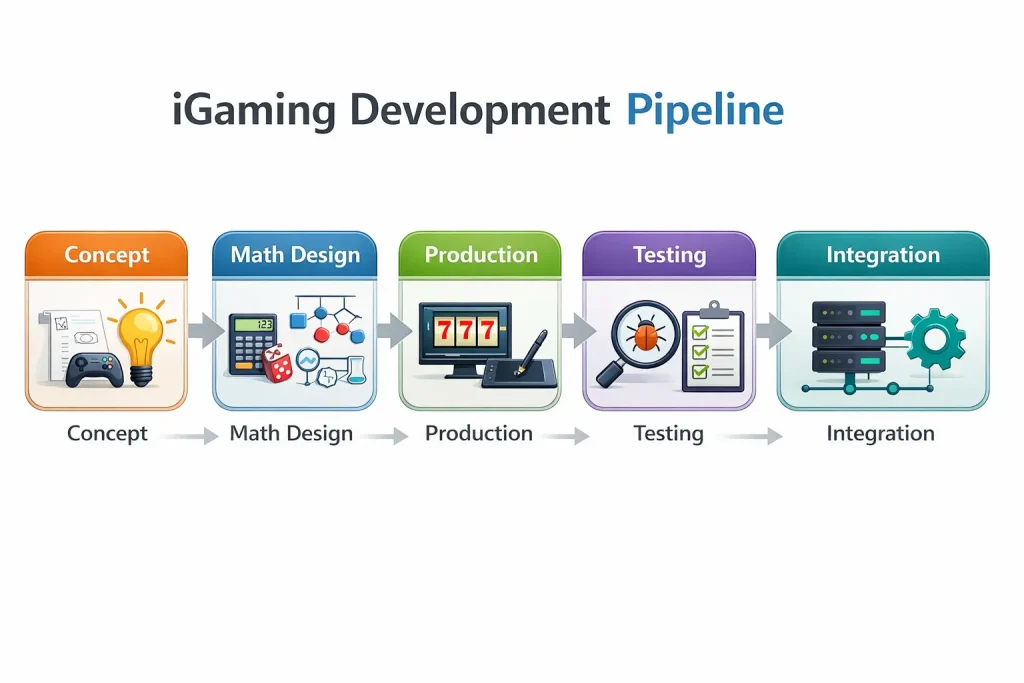
The iGaming development lifecycle refers to the structured process of creating real-money casino games from concept to launch. It typically includes concept design, mathematical modeling, game production, certification testing, and integration with casino operator platforms. This lifecycle ensures that games are both engaging for players and compliant with regulatory requirements in regulated gambling markets.
As Denys Kliuch, CEO of Whimsy Games, explains:
“iGaming development is no longer just about building a game — it’s about designing a system that balances player engagement, mathematical precision, and regulatory compliance from day one.”
The iGaming development lifecycle is the structured process of designing, building, testing, certifying, and launching real-money casino games, such as slots, crash games, and digital table games, for online gambling platforms.
Unlike traditional video game development, iGaming combines entertainment design with financial modeling and regulatory compliance. Each game must meet strict standards for payout mathematics, Random Number Generator systems, and platform integration.
This means that the lifecycle involves specialists from multiple disciplines. Designers define the gameplay concept, mathematicians construct payout models, artists build visual assets, developers implement game logic, and testing laboratories verify that the product meets regulatory standards before release.
What Are the Stages of iGaming Game Development From Concept to Launch?
To build a successful casino game, developers typically follow a structured production sequence that moves a project from concept design to certification and operator integration.
While pipelines vary between studios, the iGaming development lifecycle typically follows consistent stages that take a project from concept to live casino release.
Typical stages of iGaming development
- Concept and market research
Developers analyze player trends, select themes, and design core mechanics. This stage produces a Game Design Document detailing features, paytables, bonus systems, and visual direction. - Mathematics and system design
Casino games need a balanced financial model. Specialists define RTP, volatility, symbol distribution, and bonus event probabilities before implementing RNG logic. - Game production
Artists create symbols, characters, environments, and interface elements while developers build gameplay systems and integrate animations, sound, and visual effects. - Testing and certification
Independent labs verify payout model accuracy and Random Number Generator behavior. Certification is required for games to operate in regulated markets. - Integration and launch
The final game version is integrated with casino platforms via aggregators or APIs, localized for regions, and prepared for release in the operator’s lobby.
Each stage contributes to the game’s entertainment value and financial performance within the casino ecosystem.
In practice, studios like Whimsy Games often structure production pipelines to run multiple lifecycle stages in parallel, allowing operators to reduce time-to-market without compromising compliance or quality. This approach is especially important in competitive markets where consistent content delivery directly impacts player retention.
How Long Does the iGaming Development Process Take End-to-End?
The iGaming development timeline depends on game complexity and available production resources.
Typical development timeline
- Concept and design: 2 to 4 weeks
- Mathematical modeling: 2 to 3 weeks
- Production and development: 8 to 16 weeks
- Testing and certification: 3 to 6 weeks
- Platform integration and launch: 1 to 3 weeks
In most cases, the full production cycle takes about 4 to 6 months for a standard slot game.
For operators planning content pipelines, understanding this timeline is essential for coordinating releases and maintaining a consistent flow of new games.
Projects with complex bonus mechanics, branded content, or advanced features may take longer. Certification timelines vary by regulatory market.
Experienced teams often overlap production stages to reduce development time while maintaining compliance.
What Does the iGaming Development Lifecycle Look Like for Operators?
Casino operators view the lifecycle differently. While developers focus on production, operators prioritize content planning and player engagement.
Operator perspective on the lifecycle
- Content planning
Operators assess player preferences to select themes and game mechanics likely to succeed on their platform. - Integration and compliance coordination
Certified games connect to the operator’s system via aggregators or direct APIs, ensuring regional regulatory compliance. - Launch and promotion
- Operators introduce the game to players through marketing campaigns, lobby placement, and promotional events, such as tournaments and free-spin offers.
As online casinos release new titles continuously, operators manage multiple projects at various stages of development.
Why Many Operators Outsource iGaming Development
Developing real-money casino games requires expertise in mathematics, compliance, and platform integration. Maintaining these capabilities in-house can be resource-intensive for many operators.
Therefore, outsourcing is common in the iGaming industry. External studios support the full development process, including design, art production, engineering, testing, and certification preparation.
This approach lets operators focus on marketing, platform growth, and player acquisition while maintaining a steady content pipeline.
According to Denys Kliuch, CEO of Whimsy Games:
“The biggest shift we see today is that operators no longer look for vendors — they look for long-term development partners who understand both the technical and business sides of iGaming.”
For operators and studios alike, understanding this lifecycle helps reduce development risks, plan certification timelines, and launch casino games more efficiently.
Conclusion
The iGaming development lifecycle integrates creative design, financial modeling, engineering, and regulatory compliance into one production pipeline. From concept to final platform integration, each stage ensures the game is engaging and compliant with industry standards.
As competition in the online gambling market increases, operators rely on efficient development pipelines and experienced partners to release new titles quickly and maintain a diverse content library.
Understanding how casino games move through the development lifecycle helps both operators and studios plan production timelines, manage certification requirements, and successfully bring new games to market.