Complete Guide to Outsourcing Casino Game Development in 2026
Outsourcing casino game development can cut your production costs by up to 50% and reduce time-to-market by around 30%. That alone explains why most iGaming operators launching new titles in 2026 are no longer building in-house production teams from scratch. Instead, they are partnering with specialist studios that already have the pipelines, game mathematicians, compliance expertise, and engine know-how in place.
However, this is not as simple as signing a contract and waiting for a polished game to arrive. The outsourcing market for casino content ranges from low-cost offshore shops to full-cycle iGaming studios with certified RNG infrastructure and a decade of real deployments. The gap in quality between these options is huge. If you choose the wrong partner and end up facing delayed certification, failed RNG audits, or a game that will not integrate with your platform, the consequences land entirely on you as the operator.
This guide gives you everything you need to make a confident decision: when outsourcing makes more sense than building in-house, what a full-cycle studio actually does, how to vet a partner properly, typical cost ranges by game type, realistic timelines, and the warning signs that should stop a conversation before it goes any further.
Whether you are commissioning your very first proprietary slot or scaling a content roadmap across multiple markets, the framework below applies.
What Is Casino Game Development Outsourcing?
Casino game development outsourcing means hiring an external studio to design, build, certify, and deliver casino games for you, instead of assembling and managing a full in-house production team. The scope can be as small as a single slot or as broad as a whole content library that includes slots, crash games, scratch cards, and table games.
For most operators, outsourcing is not a second-best option. It is often the strategically correct model. Building an in-house team capable of producing a certified, market-ready slot means hiring at least a games mathematician, a front-end developer with iGaming engine experience, a back-end engineer, a QA specialist, and an art director. In Western Europe, that team alone costs between £600,000 and £1.2 million per year before you write a single line of production code.
A specialist studio bundles all of those skills under one roof, with established workflows, mature tooling, and a compliance track record already proven in multiple jurisdictions.
The Three Outsourcing Models
Not every outsourcing relationship looks the same. Most operators choose one of three models, depending on their internal capacity and goals:
- Project-based delivery: The studio owns the game from concept to launch. You provide the brief, sign off on milestones, and receive a finished, certified game. This works best for operators who want proprietary content without getting involved in day-to-day production.
- Dedicated production team: The studio assigns you a fixed team that works as an extension of your own. You keep creative and technical control; the studio provides the talent and infrastructure. This suits operators who already have game design capability but lack enough engineering or art resources.
- Staff augmentation: The studio supplies individual specialists—such as a senior slot developer, math expert, or WebGL porting specialist—to plug into your internal team on a contract basis. This is ideal for operators with mature in-house teams that just need to cover specific gaps.
Your first key decision, before you approach any game development outsourcing company, is understanding which of these models actually fits your situation.
Outsource vs Build In-House: The Decision Framework
The outsource-versus-in-house question is not just about saving money. It is about where your organisation’s core strengths lie and how quickly you need to get to market. Use the table below to assess your situation before you commit to either path.
| Decision Factor | Outsource | Build In-House |
| Time to first game | 3–6 months | 12–24 months (team build + ramp-up) |
| Upfront capital required | Low to medium (per-project fee) | High (hiring, tooling, infrastructure) |
| Compliance expertise | Included in studio capability | Must be hired or contracted separately |
| Ongoing fixed cost | Variable (project-based) | High (permanent headcount) |
| Creative control | High (with the right partner) | Full |
| Scalability | Scale up or down per project | Constrained by headcount |
| IP ownership | Negotiable; often fully transferable | Fully retained |
| Risk of failed certification | Low (experienced studio) | Higher (first-time teams) |
When Outsourcing Is the Right Call
Outsourcing makes clear commercial sense in the following scenarios:
- You are entering the market for the first time and need certified content within a defined window. Building a team from scratch takes 12 to 24 months before the first game ships.
- You want to test a new game format (crash, instant win, scratch card) without committing to a permanent team for that vertical.
- Your existing team is at capacity and you need to run parallel production tracks without a proportional headcount increase.
- You are entering a new jurisdiction that requires specific compliance credentials or localisation expertise your team does not currently hold.
- You need to reduce burn rate without reducing output. Outsourcing converts fixed staffing costs into variable project costs, which is significant for operators managing multi-market launches.
When Building In-House Makes Sense
In-house development becomes rational when you are producing at real scale (ten or more titles per year), when your games rely on deep proprietary technology you cannot or will not share with external partners, or when your competitive edge depends on tightly held, exclusive mechanics. At that level of volume and specificity, a permanent in-house team starts to make economic sense.
For most operators, that threshold is higher than it first appears.
Key takeaway: If you are producing fewer than eight to ten titles per year and do not have a hard requirement for a proprietary engine, outsourcing will almost always offer better economics and a faster time-to-market than building your own team.
What Are the Benefits of Outsourcing Casino Game Development?
Outsourcing casino game development to a specialist studio brings benefits that go far beyond simple cost savings. Here are the advantages operators consistently highlight.
Cost Reduction Without Capability Loss
The most obvious benefit is cost. A full-cycle studio works at scale: its mathematicians, artists, engineers, and QA specialists are spread across multiple projects, so overhead is shared. That makes the per-project cost for you significantly lower than maintaining comparable skills in-house.
Operators working with experienced game development outsourcing companies typically see:
- 30–50% reduction in total production cost compared to equivalent in-house delivery
- Elimination of recruitment, onboarding, and retention costs for specialist roles that are difficult to hire in competitive markets
- No tooling or infrastructure investment required; the studio’s engine licences, RNG servers, and certification relationships are already in place
Faster Time-to-Market
A studio that has shipped dozens of certified titles has already streamlined its pipeline. Art style guides, math modelling templates, QA checklists, and certification submission processes are in place and tested. This directly shortens delivery timelines.
Typical outsourced slot development timeline:
| Phase | Duration |
| Concept and game design document | 1–2 weeks |
| Mathematical modelling and RTP design | 2–3 weeks |
| Art production (symbols, UI, animations) | 4–8 weeks |
| Engineering and integration | 4–8 weeks |
| Internal QA and mathematical audit | 2–3 weeks |
| RNG certification (testing lab) | 4–12 weeks |
| Platform integration and go-live | 1–2 weeks |
With an experienced studio, a mid-complexity slot can move from brief to live launch in around three to five months. If you try to ship the same game with a newly assembled internal team, you should expect nine to fifteen months.
Access to Compliance Expertise
RNG certification is not optional in any regulated market. It is also not a formality. Labs such as BMM Testlabs and eCOGRA require exhaustive documentation, mathematical verification across millions of simulated rounds, and testing of every edge case in every bonus feature. A single error in the pay table design fails the entire submission.
Experienced studios have gone through this process many times in multiple jurisdictions. They know what the UK Gambling Commission, MGA, and other Tier-1 regulators expect, and they design compliance into the development process instead of bolting it on at the end.
Scalable Production Without Headcount Risk
One of the most underestimated benefits of outsourcing is the ability to adjust your output without hiring or redundancy cycles. If your roadmap calls for four titles in one quarter and just one in the next, a studio partner can adapt. An in-house team cannot, at least not without underutilisation and cost inefficiencies.
The bottom line: For operators that are not producing at the volume needed to justify permanent specialist roles, outsourcing is not simply cheaper. Structurally, it is the better model.
What a Full-Cycle Casino Game Development Studio Delivers
When people think about outsourcing, they often imagine a studio that “just does the coding.” In reality, a true full-cycle game development outsourcing company covers much more. Understanding the entire scope is critical if you want to avoid gaps that end up back on your desk.
The Full Production Scope
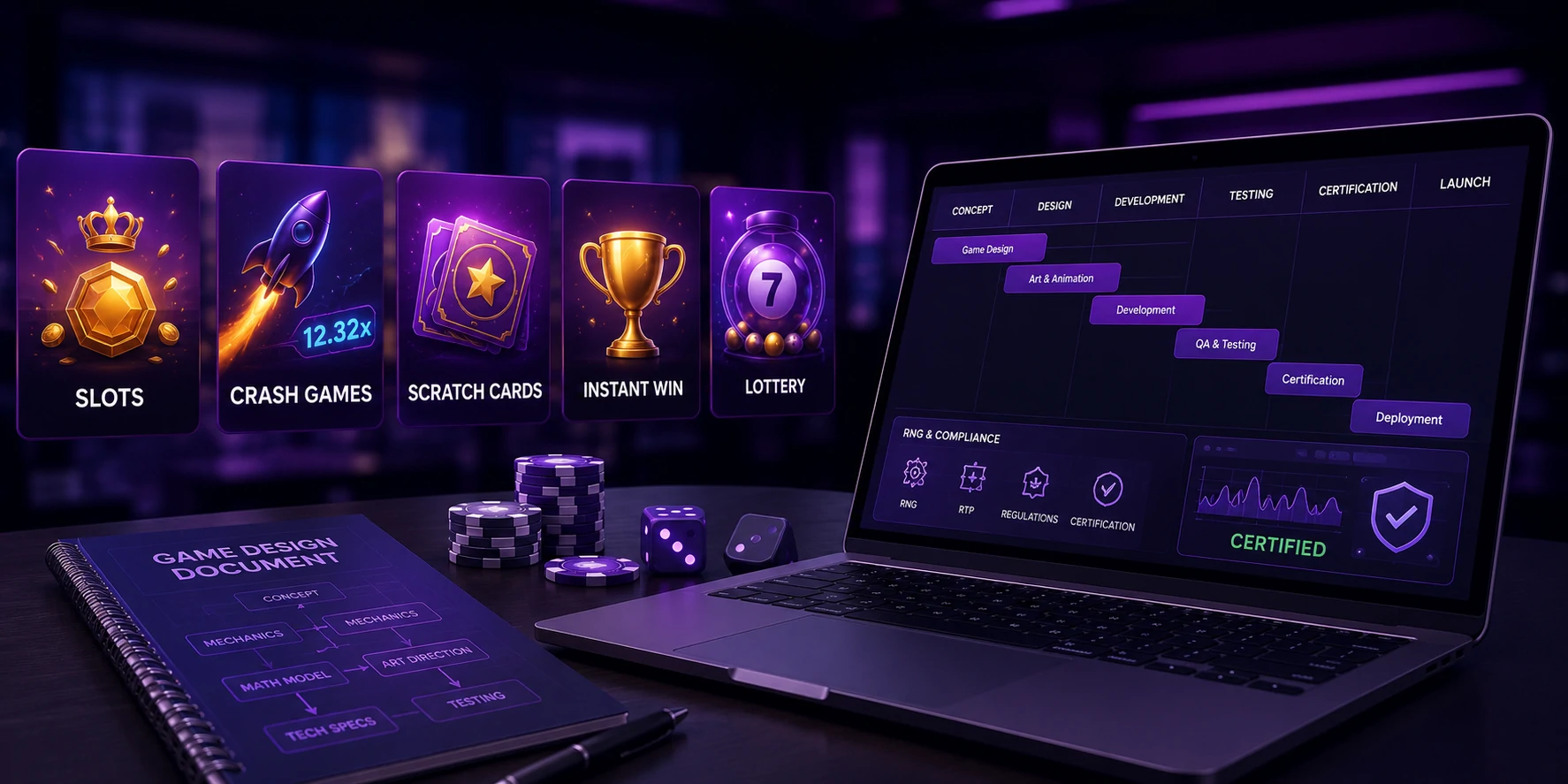
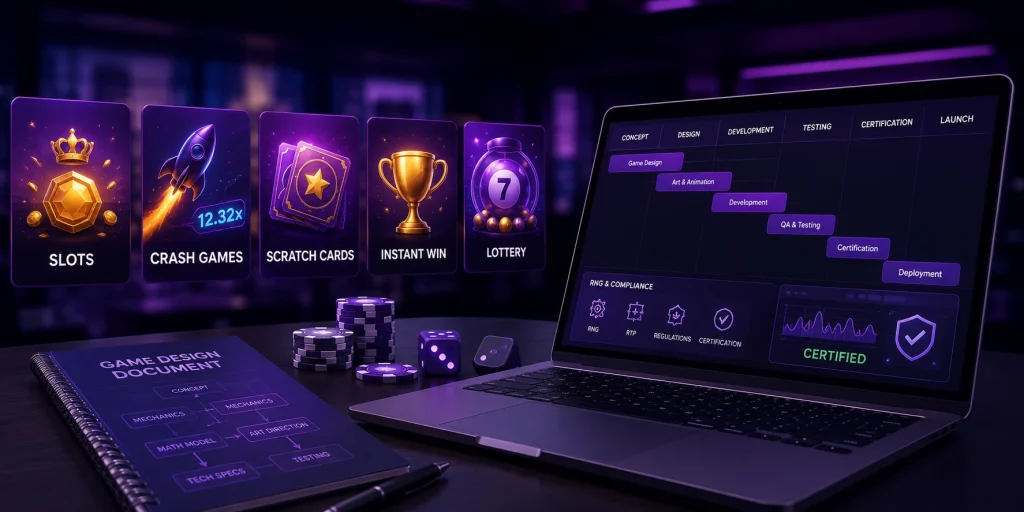
A genuine full-cycle studio covers every stage of the development lifecycle:
- Game concept and design documentation: Theme selection, mechanic definition, RTP target, volatility profile, bonus feature design, and player demographic targeting. This is where most underprepared projects fail; without a rigorous Game Design Document (GDD), every subsequent decision is contested.
- Mathematical modelling: Probability distribution modelling, pay table construction, RTP verification, and volatility calibration. This requires a specialist games mathematician, not a general software engineer. Errors at this stage fail certification and require a complete rebuild of the pay table.
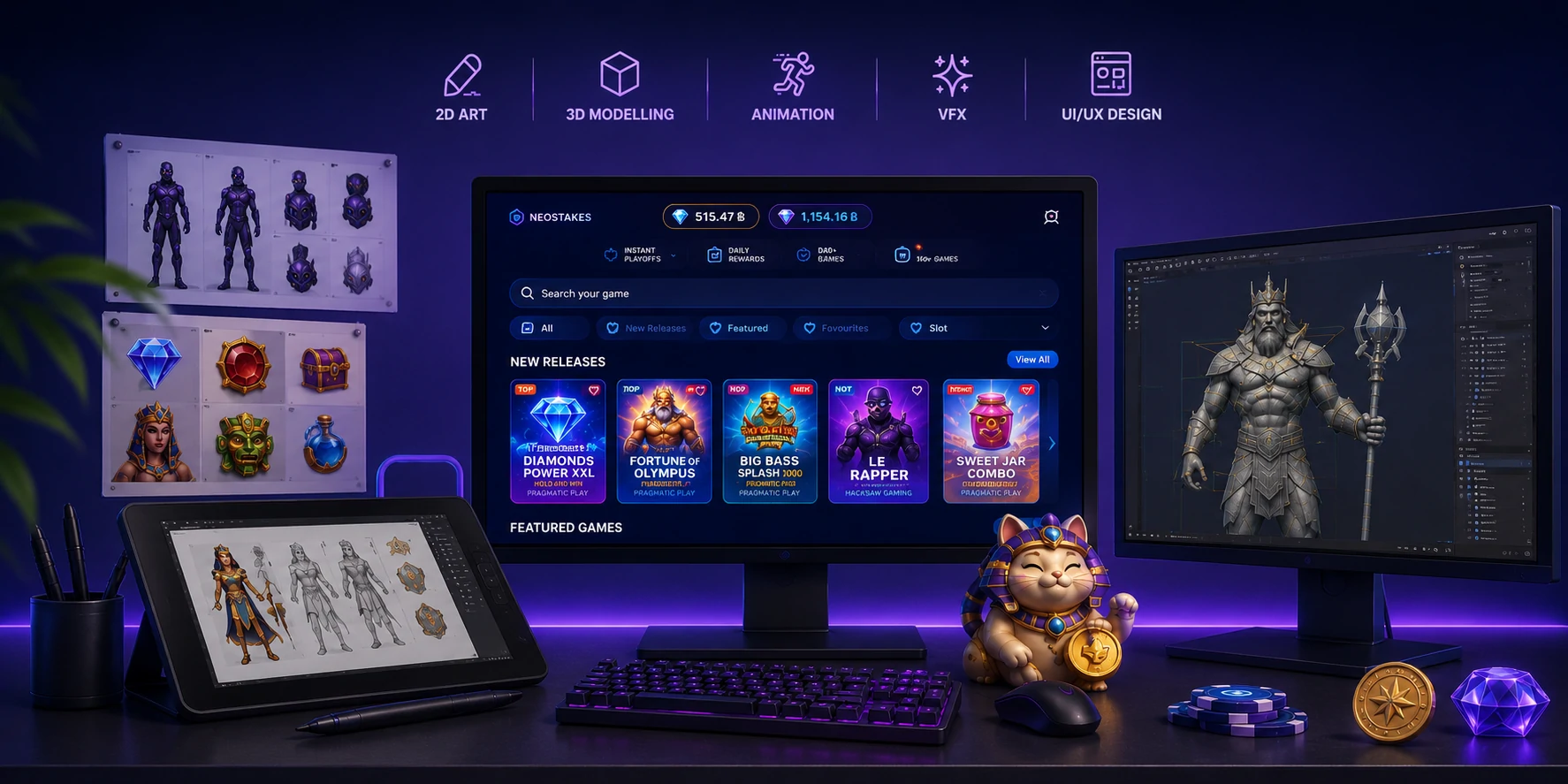
- Art and UX production: Visual theme development, symbol design, UI layout, animation, and audio. This is typically the largest single cost component of a slot project.
- Engine development: Front-end game client in HTML5 or Unity, back-end RNG server architecture, bonus mechanic logic, and platform integration API. Engine choice affects certification pathway and integration complexity.
- Quality assurance: Functional testing, performance testing, device compatibility testing, and edge-case verification across every bonus feature.
- RNG certification: Submission to an accredited testing laboratory, documentation management, and response to lab queries. This phase typically takes four to twelve weeks and runs in parallel with platform integration work.
- Platform integration and launch support: API integration with your casino platform, wallet connection, session management testing, and go-live support.
- Live operations support: Post-launch monitoring, bug resolution, and content updates.
What Separates a Full-Cycle Studio from a Development Shop
Plenty of studios can write code. Far fewer can own the entire chain from GDD to certified live deployment. That difference matters. If any link is weak—no mathematician, no real certification experience, an art team that does not understand iGaming UX—it becomes your problem mid-project.
Studios like Whimsy Games, with eight years of experience in iGaming and a team of 75 specialists, keep all of these capabilities in-house. Having successfully released 15 games across multiple formats, the company demonstrates the expertise and integrated approach operators should expect from a full-cycle development partner. That is the standard you should be measuring potential partners against.
A useful question set for any studio: “Show me one game you took from GDD to certified live launch. Who did the math? Who managed the lab submission?” If they cannot answer both clearly and specifically, they are not a full-cycle studio.
How to Outsource Slot Game Development to Professional Studios
Outsourcing slot game development is a structured process. Operators who follow that structure tend to get better results, more predictable timelines, and fewer surprises. Here is how the journey usually looks from initial idea to live game.
Step 1: Define Your Brief Before Approaching Studios
The single most common cause of project delays and cost overruns is an incomplete brief. Before contacting any game development outsourcing company, you should have documented:
- Game type: Slot, crash game, scratch card, table game, or instant win
- Target market and jurisdiction: Determines RTP constraints, certification requirements, and localisation scope
- Volatility and RTP target: High-volatility titles attract different player segments than low-volatility ones; this decision should be data-driven
- Bonus feature requirements: Free spins, multipliers, cascading reels, hold-and-spin mechanics
- Platform and integration requirements: Which aggregator or platform the game will be deployed on, and what API format is required
- Art direction: Theme, visual style reference, and any brand guidelines
- Budget and timeline: A realistic range, not a target designed to test the studio’s limits
Studios that receive a complete brief can quote accurately and commit to timelines. Studios that receive a vague brief will quote low and manage scope creep later.
Step 2: Shortlist Studios Based on Verified Criteria
Not every company calling itself a game outsourcing studio can deliver a certified iGaming title. At the shortlisting stage, filter for:
- Verifiable portfolio of delivered, live casino games (not renders or prototypes)
- Demonstrable compliance and certification track record
- Engine expertise in HTML5 or Unity (the two dominant stacks for regulated markets)
- References from operators in your target jurisdiction
Step 3: Conduct a Structured Evaluation
Request a technical discovery call with each shortlisted studio. The agenda should cover their production process, how they handle mathematical modelling, their certification experience, and their approach to platform integration. Ask to speak with the mathematician and the technical lead, not just the account manager.
Step 4: Agree the Contract Structure
The contract should specify:
- Milestone-based payment schedule tied to deliverable sign-offs, not calendar dates
- IP ownership: Confirm that all game assets, code, and mathematics transfer to you on final payment
- Certification responsibility: Who manages the lab submission and who bears the cost of resubmission if the first submission fails
- Revision scope: How many rounds of art and mechanic revisions are included, and what triggers additional cost
- Post-launch support: Duration and scope of bug-fix support after go-live
Step 5: Run the Project with Structured Milestone Reviews
Treat the studio as a partner, not a black box. Weekly check-ins, shared project management tools, and formal sign-offs at GDD completion, art approval, and QA sign-off keep the project from drifting and avoid last-minute surprises.
One thing many operators underestimate: certification timelines are outside the studio’s direct control once the lab has the game. Lab queues are seasonal; Q3 submissions (July–September) tend to move fastest. Q4 submissions, especially those aiming for the pre-Christmas peak, usually face longer waits. Plan for four to twelve weeks of lab time as a fixed milestone, not a flexible buffer.
What to Look for When Hiring a Casino Game Development Company
The criteria that separate a solid studio from an expensive mistake are specific and checkable. Broad statements like “we communicate well” or “we have an experienced team” do not tell you much. Focus on the following.
Portfolio: Live Games, Not Demos
Ask for links to games that are live on regulated casino platforms. Do not rely on videos, screenshots, or prototype builds. A live game has gone through the full cycle: it has a certified RNG, passed lab testing, and been integrated with a production platform. That is completely different from a demo built for a sales pitch.
When reviewing the portfolio, look for:
- Game variety: Studios that have delivered slots, crash games, scratch cards, and table games have a broader production capability than those focused on a single format
- Visual quality: Does the art direction meet the standard of titles currently performing in your target market?
- Mechanic sophistication: Are the bonus features genuinely differentiated, or are they reskins of standard templates?
Compliance Track Record
This is often overlooked—and it is where the most damage happens. Ask directly:
- Which testing labs has the studio submitted to? (GLI, BMM, eCOGRA, iTech Labs are the major accredited labs)
- How many certification submissions have they managed?
- What is their first-submission pass rate?
- Have they delivered certified titles for the UK Gambling Commission, MGA, or other Tier-1 regulators?
A studio that cannot answer these questions with specifics has not navigated the certification process at scale.
Engine Expertise
The two dominant stacks for regulated iGaming are HTML5 (required for cross-platform browser delivery) and Unity (used for richer 3D environments and mobile-first titles). Both have distinct certification pathways and integration requirements. A studio that is expert in one but not the other is limited in what it can deliver.
Also confirm:
- RNG architecture: Does the studio operate its own certified RNG server infrastructure, or does it rely on a third-party provider? Both are acceptable; what matters is that the RNG is accredited and the studio understands the architecture.
- Platform integration experience: Has the studio integrated with your specific aggregator or platform? Integration complexity varies significantly between platforms.
Team Composition and Transparency
A credible studio should be able to show you who will work on your project. The minimum team for a slot project is:
| Role | Why It Matters |
| Games mathematician | Designs and validates the pay table; errors here fail certification |
| Front-end developer | Builds the game client in HTML5 or Unity the game client in HTML5 or Unity |
| Back-end engineer | Builds the RNG server and bonus logic |
| Art director | Ensures visual quality meets market standard |
| QA specialist | Tests every mechanic against the GDD before lab submission |
| Project manager | Coordinates milestones and client communication |
If a studio cannot name the mathematician on your project, that is a serious concern.
Commercial Terms and IP Clarity
Confirm before signing that:
- All IP (code, art assets, mathematics, documentation) transfers to you on final payment
- The contract specifies what happens if certification fails and who bears resubmission costs
- There is a clear change-request process with defined pricing for scope changes
Studios with strong delivery track records are comfortable with these terms. Studios that resist IP transfer clauses or certification cost clarity are signalling that they expect problems.
Red Flags That Should End the Conversation
The iGaming outsourcing market includes many studios that look convincing on the surface but cannot deliver to regulated standards. The following patterns show up repeatedly in failed partnerships.
Portfolio Red Flags
- No live games, only demos or renders. A studio that cannot point to titles currently live on a regulated platform has not completed the full production cycle.
- Portfolio games are visually inconsistent. Significant variation in art quality across a portfolio often indicates the studio subcontracts art production without quality control.
- Games are not findable on any casino platform. If you cannot verify that the games in the portfolio are actually deployed and operational, treat the portfolio as unverified.
Compliance Red Flags
- Vague answers about certification experience. Any studio that has managed a real lab submission knows exactly which labs they have worked with and how many submissions they have made.
- No mention of RNG architecture. A studio that does not proactively address how the RNG is built and certified is likely outsourcing that component without understanding it.
- Offering to skip certification “for speed.” This is not a shortcut. It is a guarantee of regulatory problems in any market that requires certified content.
Commercial Red Flags
- Unusually low quotes. A slot game that is quoted at under $10,000 for a full production cycle is not a bargain. It is a scope that excludes mathematics, proper QA, or certification.
- Resistance to milestone-based payment. Studios that insist on large upfront payments without milestone-linked deliverables are transferring financial risk to the operator.
- Ambiguous IP terms. Any contract that does not explicitly state that all assets transfer to the operator on final payment should be reviewed by legal counsel before signing.
- No named mathematician. If the studio cannot identify who will design and validate the pay table, that function is either absent or outsourced to an uncredentialled freelancer.
Communication Red Flags
- Account managers who cannot answer technical questions. In a credible studio, the account manager can escalate technical questions to the relevant specialist immediately. If every technical question is met with “I will get back to you,” the technical team is not accessible.
- Reluctance to provide client references. A studio with 85+ delivered projects has clients who will speak to their experience. Reluctance to provide references is a meaningful signal.
The practical filter: Ask for two client references from operators in your target jurisdiction. Call them. Ask specifically about certification experience, how the studio handled problems mid-project, and whether they would commission another game. The answers will tell you more than any pitch deck.
Cost Ranges and Timeline Expectations in 2026
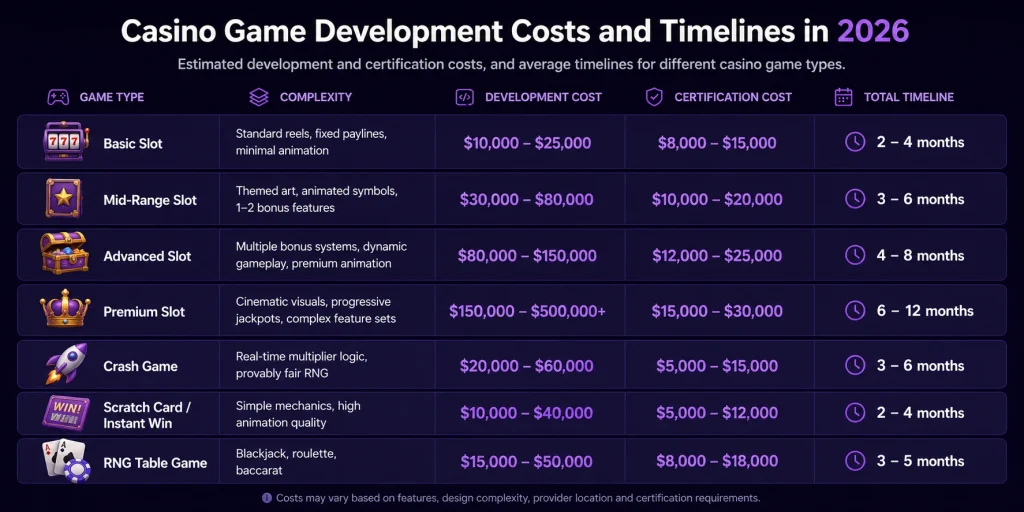
Cost and timeline are the two questions operators ask first—and the two areas where misrepresentation is most common. The ranges below reflect real budgets for outsourced casino game development in 2026, based on published industry data and Whimsy Games’ experience across 85+ delivered projects.
Development Cost by Game Type
Regional Rate Benchmarks
Hourly development rates vary significantly by region, and this is the primary lever that affects total project cost when comparing studios. According to published rate data for the iGaming sector:
- Western Europe: $120 – $200 per hour
- Eastern Europe: $80 – $140 per hour
- Asia: $25 – $70 per hour
Eastern European studios represent the strongest value-to-quality ratio for most iGaming projects. They operate at rates 30–40% below Western European equivalents while maintaining the compliance knowledge and production standards that regulated markets require. Asian studios offer the lowest rates but typically carry higher risk around compliance expertise and first-submission certification pass rates.
What Drives Cost Up
Several factors consistently push projects above initial estimates:
- Scope changes after GDD sign-off. Adding a bonus feature after engineering has started is significantly more expensive than defining it at the brief stage.
- Complex platform integrations. Integrating with a non-standard aggregator API or a proprietary platform can add two to four weeks of engineering time.
- Certification resubmissions. A failed first submission adds $5,000 – $15,000 in lab fees and four to eight weeks to the timeline.
- Art revisions beyond the agreed scope. Unlimited revision cycles are not standard; define the revision scope in the contract.
What Drives Cost Down
- Clear, complete brief at project start. Studios can price accurately and avoid scope creep.
- Reusing established art frameworks. Building on an existing visual style rather than developing a new art direction from scratch reduces art production time.
- Flexible timeline. Projects with hard launch deadlines often require premium resourcing. A flexible window reduces cost.
The number to hold in mind: A properly scoped mid-range slot with full certification, delivered by a credible Eastern European studio, should land in the $50,000 – $100,000 range all-in. Quotes significantly below this floor should prompt scrutiny about what has been excluded.
Why Whimsy Games
Whimsy Games is a full-cycle iGaming studio headquartered in London with eight years of industry experience and a team of 75 specialists. The company has successfully released 15 games for operators, platforms, and aggregators worldwide, including slots, crash games, scratch cards, instant-win titles, and lottery modernisation projects.
The production capability spans the full development lifecycle:
- Mathematical modelling and RTP design handled in-house by specialist games mathematicians
- Art and UX production across 2D and 3D formats, with an established style guide library for rapid visual development
- Engine expertise in both Unity and HTML5, covering the full range of regulated market requirements
- AI-assisted workflows in art production and development, which reduce production time without compromising quality
- End-to-end project delivery from Game Design Document to certified live deployment, with post-launch live ops support
Whimsy Games offers three main engagement models: turnkey project-based delivery, dedicated production teams embedded into client workflows, and staff augmentation for senior specialist roles such as slot developers, math experts, and WebGL porting engineers.
Whimsy Games offers three main engagement models: turnkey project-based delivery, dedicated production teams embedded into client workflows, and staff augmentation for specialist roles such as slot developers, math experts, and WebGL engineers.
For operators evaluating a game development outsourcing company, the Whimsy Games portfolio and case studies showcase successfully delivered games across multiple formats, including slots and quick games.