How to Hire iGaming Game Artists: 2D, 3D, and Animator Rates in 2026
Hiring a 2D iGaming artist in 2026 typically costs between $35 and $120 per hour, depending on region, experience, and specialisation. That range tells you something important: the choices you make at the very start of the process — who you hire, and in what format — will shape your budget more than almost any other production variable.
For operators and publishers commissioning slot art, the real problem usually isn’t finding artists. It’s choosing the right engagement model, knowing how to read a portfolio for iGaming‑specific signals, and putting a contract in place that actually protects your IP when the project is over. This guide walks through all three.
What we’ll cover:
- Freelancer vs. agency vs. staff augmentation: which model fits which project
- Rate benchmarks by region for 2D artists, 3D artists, and animators
- Portfolio evaluation checklist: what to look for, and what to avoid
- Contract essentials: IP ownership, revision rounds, and NDA terms
- Red flags in proposals that operators miss until it’s too late
Freelancer, Agency, or Staff Augmentation: Choosing the Right Model
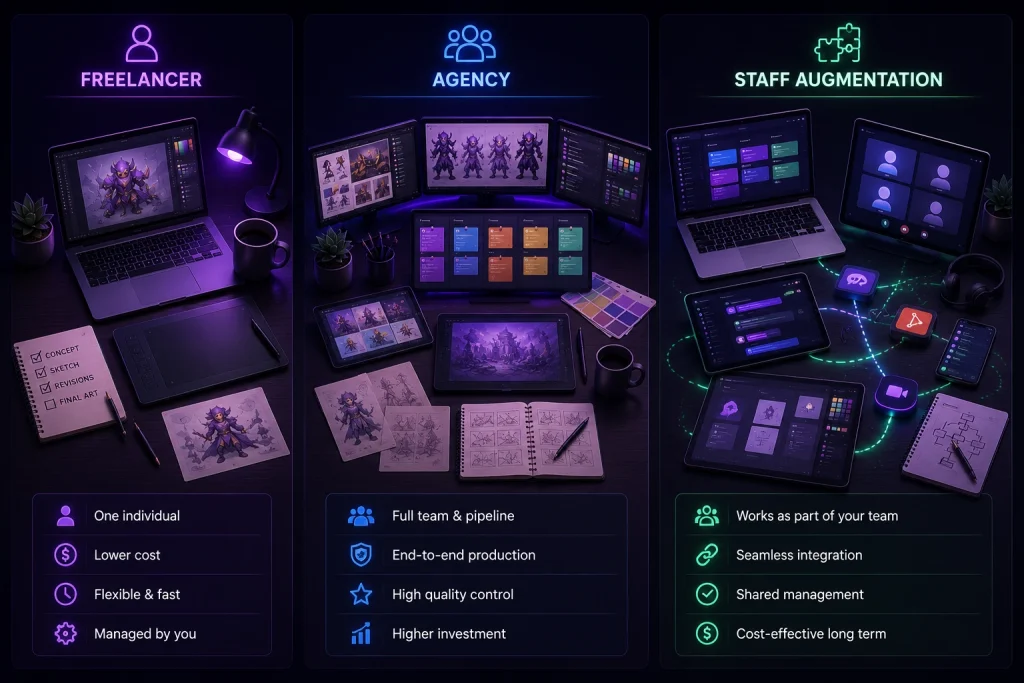
The engagement model you choose determines your cost structure, how much control you have, and how much risk you’re taking on. There’s no single “best” option — but there is a model that’s best for your specific project.
Freelancer
Hiring a 2D game artist on a freelance basis works well for clearly scoped, asset‑level tasks: a batch of symbols, a single character, a UI refresh. Rates are usually the lowest of the three models, and you communicate directly with the artist.
The hidden cost is management. Most freelancers won’t handle brief interpretation, revision cycles, or production scheduling without someone steering them. If you don’t have an art director or producer who can stay close to the work, freelance projects regularly drift 30–40% over budget because of rework.
Best for: Small asset packages, one‑off reskins, or supplementary art when your in‑house team needs extra capacity.
Game Art Agency
An agency gives you a full production pipeline: art direction, concepts, production, and QA all under one roof. You’re paying for that coordination layer, which is why agency rates are higher. For a complete slot title — themed symbols, backgrounds, UI, and animation — that overhead is usually worth the premium.
The risk with agencies is style dilution. If the studio is juggling several clients at once, your project may be executed by junior artists who are only overseen by a senior. Always ask who will actually be doing the production work, not just who will manage the account.
Best for: Full slot title production, turnkey art packages, and projects where you want a single point of accountability.
Staff Augmentation
Staff augmentation sits somewhere in between. You bring on a dedicated artist or small team who plugs into your pipeline, works your hours, and uses your tools. They’re employed by the studio, so you avoid HR overhead, but day‑to‑day they operate as an extension of your internal team.
This model is increasingly common among operators building proprietary content. It gives you continuity (the same artist learns your style guide over time) without the cost of full employment. According to industry benchmarking data, Eastern European art outsourcing delivers 50-65% cost savings versus US in-house artists on a fully loaded basis.
Best for: Ongoing content pipelines, studios releasing multiple titles per year, and operators who want a consistent visual identity across their game catalogue.
Quick Comparison
If you’re deciding between freelancers, agencies, and staff augmentation, here’s a quick overview of how they compare in terms of cost, management effort, and the types of projects they’re best suited for.
| Model | Best For | Cost Level | Management Required |
| Freelancer | Single assets, small scope | Low | High (by client) |
| Agency | Full title production | Medium-High | Low (agency manages) |
| Staff Augmentation | Ongoing pipeline, embedded team | Medium | Medium (shared) |
There’s no universal “best” engagement model. Freelancers work well for small, clearly defined tasks, agencies are ideal for full-cycle game art production, while staff augmentation offers the best balance for long-term content pipelines and teams releasing multiple iGaming titles each year.

Rate Benchmarks by Region: 2D Artists, 3D Artists, and Animators in 2026
Geography is the single biggest lever on cost. The same mid‑senior 2D slot artist can cost roughly three times as much in the UK as in Eastern Europe — and twice as much in Eastern Europe as in Southeast Asia. Understanding what you get at each price point is just as important as knowing the numbers.
2D iGaming Artist Rates
| Region | Entry-Level | Mid-Senior | Senior/Specialist |
| UK / Western Europe | $70-90/hr | $90-120/hr | $120-160/hr |
| Eastern Europe (Poland, Romania, Serbia) | $35-50/hr | $50-75/hr | $75-100/hr |
| Southeast Asia (Philippines, Vietnam, Indonesia) | $20-35/hr | $35-55/hr | $55-80/hr |
Remember: The lowest hourly rate doesn't always result in the lowest project cost. Revision rounds, communication quality, and familiarity with iGaming production pipelines often have a much bigger impact on your final budget.
For slot‑specific 2D work (symbol sets, reel frames, bonus art), Eastern European studios consistently offer one of the best quality‑to‑cost ratios. Strong English communication, workable timezone overlap with Western Europe, and a long track record in game art production make this region the default choice for many operators.
3D Artist and Animator Rates
3D work carries a premium across all regions because the toolchain is more specialised and the production time per asset is higher.
| Role | Eastern Europe | Southeast Asia | UK / Western Europe |
| 3D Character Artist | $50-100/hr | $30-60/hr | $100-180/hr |
| Environment Artist | $45-90/hr | $25-55/hr | $90-160/hr |
| Animator (2D Spine/Rig) | $40-80/hr | $25-50/hr | $80-140/hr |
| Animator (3D Rigged) | $55-100/hr | $35-65/hr | $100-170/hr |
| VFX Artist | $60-110/hr | $35-70/hr | $110-180/hr |
Sources: Glassdoor Salary Data 2025-2026; ArtStation Job Board Reports 2025; GDC 2025
The Real Cost of Cheap
Studios charging $15–25 per hour are out there. On paper, that looks attractive. In practice, the extra revision cycles, misunderstood briefs, and rework at that level often add 40–60% to your real project cost.
The metric that actually matters isn’t the hourly rate — it’s cost per approved asset. A $40/hr Eastern European artist who delivers clean work in two revision rounds is cheaper than a $20/hr provider who needs five rounds and still doesn’t quite hit the brief. When you plan your budget, build in expected revision cycles, not just the headline rate.
For additional context: a single mid‑level 3D artist employed in‑house in the UK costs roughly £60,000–£90,000 per year in salary alone, before benefits, equipment, and management overhead. A dedicated, outsourced senior artist from an Eastern European studio working comparable hours usually comes in around £30,000–£50,000 annually, with no HR overhead. The difference can fund extra titles.
How to Evaluate a Slot Game Art Portfolio
Most operators look at portfolios the wrong way. They focus on whether the work looks impressive. The better question is whether the work is slot‑appropriate: does it show an understanding of reel mechanics, symbol hierarchy, and the visual grammar of iGaming?
A portfolio that looks stunning in a general game art context can still be a poor fit for a slot title. Here’s how to assess it.
Style Range vs. Style Consistency
You’re aiming for both range and consistency — and they signal different things.
A provider who only shows one visual style (for example, exclusively dark fantasy) may struggle to adapt to your theme. On the other hand, a studio with lots of different styles but no consistent quality floor is a different kind of risk.
Look for 3–5 distinct visual styles delivered at a similar level of quality. That usually points to a mature production process rather than one standout artist whose work is carrying the portfolio.
Slot-Specific Experience Signals
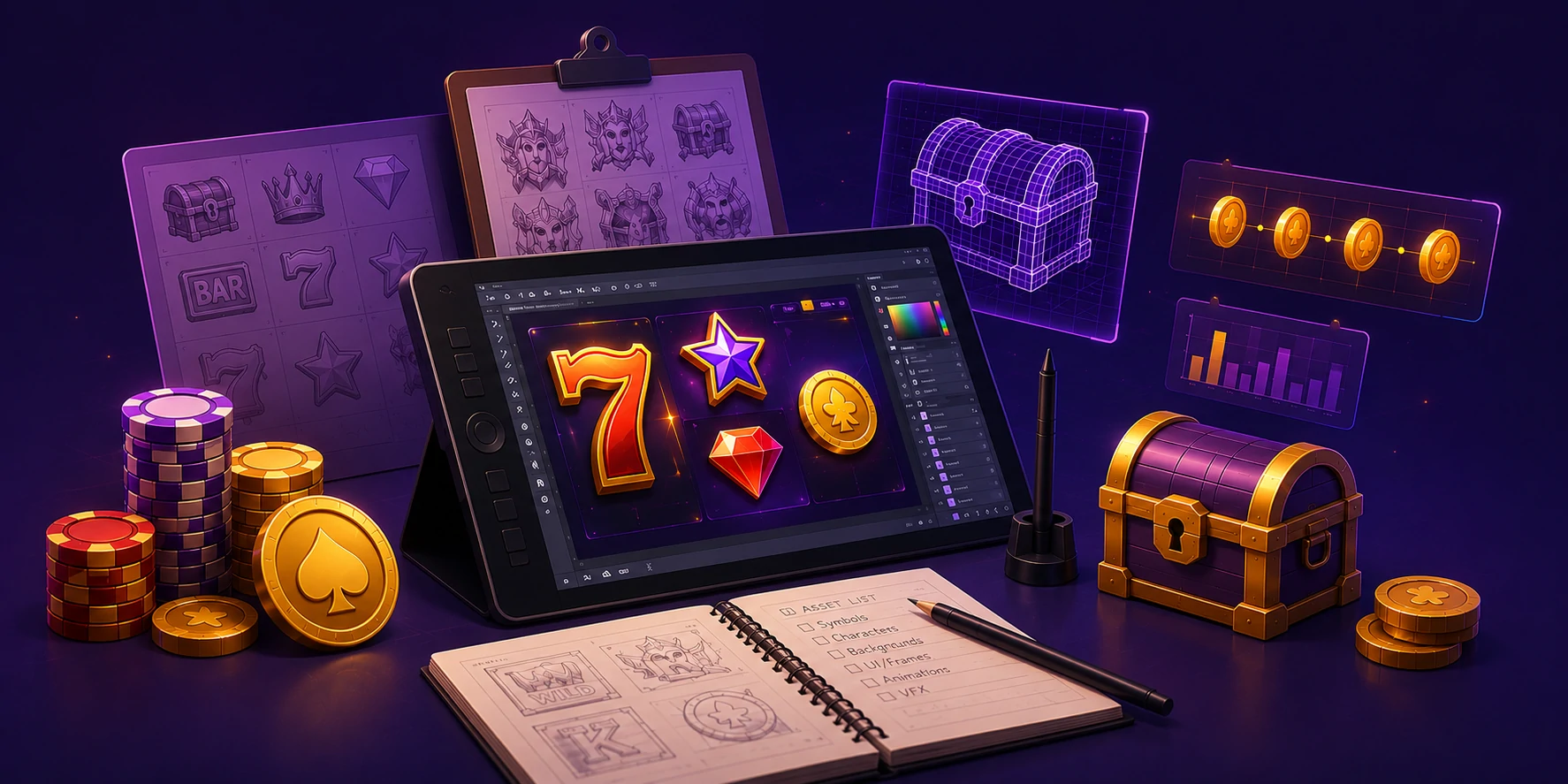
Generic game art and iGaming art aren’t the same discipline. Slot art has its own constraints: symbols must read clearly at small sizes, bonus screens have to communicate hierarchy at a glance, and animations should loop cleanly without visual stutter.
A portfolio full of concept art, character illustrations, or standalone environments doesn’t prove the studio can work inside those constraints.
Look for:
- Symbol sets with clear visual hierarchy (premium, mid, low-value distinction)
- Reel and frame artwork that respects the UI layer
- Bonus game environments with legible interactive elements
- Win animations that are punchy without being distracting
Animation Quality
Animation is where iGaming art separates itself from general game art. Slot animations must be technically clean (no frame drops, no artefacts), emotionally satisfying (the win animation must feel rewarding), and appropriately scoped (not so complex they impact performance on mobile).
Ask the studio to show you animation files, not just screenshots. A still frame of a character tells you nothing about whether the idle animation loops correctly or whether the win sequence has timing that players will find satisfying.
Portfolio Evaluation Checklist
Use this checklist when reviewing any slot game art provider’s portfolio:
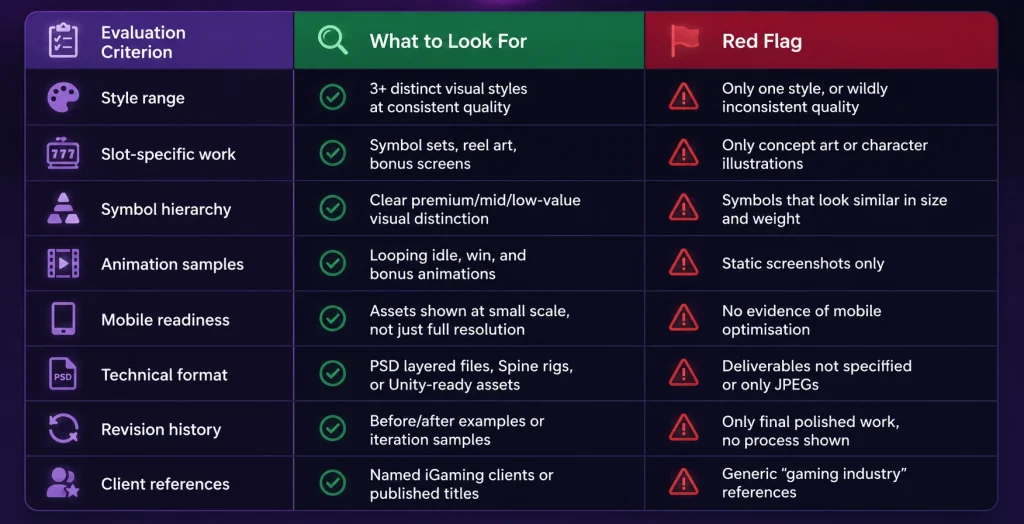
Key takeaway: A studio that cannot show you published iGaming titles or named operator clients is not necessarily a bad choice, but it is an unproven one. Weigh that risk against the rate differential accordingly.
For a reference point on what published slot art looks like across different visual styles, Whimsy Games’ portfolio covers 100+ delivered projects across multiple themes and operators.
Red Flags in Proposals: What Operators Miss
The proposal stage is where most hiring mistakes are made. Operators focus on the price and the portfolio, and overlook the structural signals that predict whether a project will run smoothly or fall apart mid-production.
Vague Deliverable Definitions
A proposal that lists “slot art package” without specifying asset count, resolution, format, and included revision rounds is not a proposal. It is an opening position in a negotiation that will happen later, at your expense. Any professional studio should be able to specify:
- Exact number of symbols, backgrounds, and UI elements
- File formats on delivery (PSD, PNG, Spine, Unity prefab)
- Number of included revision rounds per asset
- Timeline broken down by milestone, not just total duration
If these are absent from the initial proposal, request them before signing. If the studio resists providing specifics, treat that as a hard stop.
No Art Direction Stage
Skipping concept approval is the single most common cause of expensive rework. A studio that wants to jump straight to final art without a concept or style‑frame approval stage is optimising for speed — at your risk.
The outcome is predictable: you receive finished assets that don’t match what you had in mind, and the revision bill ends up higher than the cost of a proper concept phase.
At minimum, insist on one approved style frame or character concept before production begins on any major asset category.
Unusually Low Rates With No Explanation
A rate that sits well below the regional benchmark isn’t automatically a bargain. Until you understand why it’s so low, treat it as a red flag.
Common explanations include:
- The work is being quietly subcontracted to a lower‑cost market
- The “senior artist” shown in the pitch deck won’t be the one doing the work
- The studio is underpricing to win the project and plans to recover margin through change orders
Ask directly: “Who will be executing the production work, and where are they based?” A confident, experienced studio will answer this very clearly.
No Process for IP Transfer
If the proposal never mentions intellectual property transfer, bring it up immediately. By default, in many jurisdictions the creator of a work owns it unless there’s a written agreement that says otherwise.
A studio that doesn’t proactively address IP ownership either hasn’t dealt with it before (inexperienced) or prefers the ambiguity (a risk you don’t want on a title you plan to commercialise).
Contract Essentials for iGaming Art Commissions
A well-structured contract is not bureaucracy. It is the document that determines whether you own your assets, how disputes are resolved, and what happens if the studio delivers late or below standard. For iGaming art specifically, four clauses carry the most weight.
IP Ownership and Assignment
Your contract should state clearly that all intellectual property created under the agreement transfers to you upon final payment. That includes source files, layered PSDs, Spine rigs, animation data, and any derivative works.
“Work for hire” language is the usual approach in UK and US contracts. If the studio is based in a country where work‑for‑hire isn’t a recognised legal concept (which is the case in some Eastern European markets), the contract should include an explicit IP assignment clause that achieves the same outcome.
Do not accept wording that only grants you a licence to use the assets while the studio retains ownership. That becomes a problem the moment you want to reskin, sell, or white‑label the title.
Revision Rounds
Define the number of included revision rounds per production stage: concept, sketch, colour, and final. Two rounds per stage is a common standard.
Also define the difference between:
- A revision (a change within the agreed brief), and
- A scope change (a new direction that goes beyond the original brief)
Scope changes should trigger a separate change order with its own cost and timeline. Studios that don’t draw this line often absorb scope creep silently and then claw back the time through reduced quality or missed deadlines.
NDA and Confidentiality
For any title in development, the studio should sign an NDA before receiving your brief. This is standard practice and any professional studio will have a template. If you need a starting point, the GOV.UK guidance on intellectual property covers the basics of IP protection under UK law. The NDA should cover:
- Your game concept, mechanics, and visual direction
- Any proprietary style guides or brand assets shared during production
- Client identity (relevant if you are building under a white-label arrangement)
Milestone-Based Payment
Never pay the full project fee upfront. A milestone-based structure protects both parties: you retain leverage to ensure quality, and the studio has a clear schedule of payments tied to deliverables.
A typical structure for a slot art package:
| Milestone | Payment |
| Contract signing | 20-30% |
| Concept and style-frame approval | 20-25% |
| Mid-production asset delivery | 25-30% |
| Final delivery and file handover | 15-20% |
For ongoing staff augmentation arrangements, monthly invoicing is standard. Ensure the contract specifies a notice period (typically 30-60 days) for either party to exit the arrangement.
For a detailed breakdown of what full-cycle slot development costs at each stage, see the casino game development cost guide on the Whimsy Games blog.
Making the Decision: A Practical Framework
Before you send the first brief, answer three questions. The answers will tell you which engagement model to use, which region to target, and what to prioritise in your contract.
1. Is this a one-time project or an ongoing need? One-time: agency or freelancer. Ongoing: staff augmentation or a retained agency relationship with a dedicated team.
2. Do you have internal art direction capacity? Yes: freelancer or staff augmentation gives you more control at lower cost. No: agency is the safer choice; you are paying for the art direction layer you do not have in-house.
3. How important is IP sensitivity? High (proprietary title, white-label arrangement, licensed IP): prioritise Western European or UK-based studios, or Eastern European studios with strong English-language contracts and explicit IP assignment clauses. Lower: Southeast Asian studios offer excellent value for high-volume asset production.
Comparing Providers: What to Ask
When you are down to two or three shortlisted providers, these questions separate professional studios from those that will cost you money in the long run:
- “Can you show me the Spine or animation files from a previous slot project, not just rendered video?”
- “Who specifically will be working on our project, and what is their experience with iGaming titles?”
- “What is your process when a client changes direction mid-production?”
- “Do you have an NDA template, or should we provide one?”
- “What happens if we need to reskin this title in 18 months?”
A studio that answers these confidently, with specifics, has done this before. A studio that deflects, generalises, or needs time to check with management is telling you something about how the project will run.
For operators evaluating full-cycle development options alongside art outsourcing, the casino game development services page covers how integrated art and development pipelines reduce handover friction and total production cost.