
Slot Math Design: RTP, Volatility, Bonus Buy, and MEGAWAYS Mechanics Explained
Slot math design determines how a game feels to play, how long it retains players, and whether it passes certification. It is also the single most consequential set of decisions a studio makes during development, yet it is frequently treated as an afterthought to art direction and feature design.
That order of priorities is backwards. Math is the product. The theme, the animations, the sound design: all of these serve the math model. A beautifully executed slot built on a poorly calibrated math framework will churn players, fail operator KPIs, and potentially fail regulatory submission. A mathematically sound game can succeed even with modest production values.
This guide covers the full math design stack for operators and studio leads: RTP requirements by jurisdiction, volatility tiers and their commercial use cases, bonus buy mechanics and where they are now prohibited, MEGAWAYS and cluster pays architecture, and what certification actually requires from your math documentation.
Key areas covered in this article:
- RTP floors and ranges by regulated market (UK, MGA, and beyond)
- Volatility tiers: low, medium, high, and extreme, mapped to player segments and operator objectives
- Bonus buy mechanics: how they work, how they affect math, and their current regulatory status
- MEGAWAYS and cluster pays: architecture, licensing, and design implications
- Math model testing and certification requirements (GLI-11, GLI-16, iTech Labs)
- FAQ: the most common questions from operators and studio leads
RTP: The Foundation of Every Math Model
Return to Player (RTP) is the percentage of all wagered money a slot returns to players over a statistically significant number of spins. A game with 96% RTP returns £96 for every £100 wagered, in theory, across millions of spins. In practice, individual sessions deviate wildly from that figure; that deviation is volatility, covered in the next section.
RTP is not a player-facing marketing number. It is a regulatory compliance threshold, a certification parameter, and a commercial lever that operators use to manage margin. Understanding where each jurisdiction sets its floor is non-negotiable before a math model is finalised.
RTP Requirements by Regulated Market
Different licensing bodies set different minimum RTP floors, and these directly constrain your math design options:
| Jurisdiction | Regulator | Minimum RTP | Notes |
| United Kingdom | UKGC | 94% | Industry practice targets 94–96%; stake caps (£2/£5) now apply |
| Malta (MGA) | Malta Gaming Authority | 92% | Applies to B2C licensees; B2B suppliers follow operator market rules |
| Gibraltar | GBGA | 94% | Broadly aligned with UK standards |
| Isle of Man | GSC | 92% | Flexible; lab-verified RTP required |
| Sweden | Spelinspektionen | 94% | Stricter responsible gambling overlays |
| Netherlands | KSA | 94% | New licensing regime; RTP verification required |
| Curaçao | CGA | 90% | Offshore default; often used for crypto-native operators |
The practical implication: studios building for multi-market distribution need to design math models that satisfy the strictest market in their target portfolio. Designing to 94% UK floor gives you room to deploy across MGA and Curaçao markets without resubmission. Designing to 92% MGA and then attempting UK certification requires a full math revision.
RTP Localisation: A Growing Requirement
The concept of RTP localisation, offering different certified RTP variants of the same game for different markets, has become standard practice for studios targeting regulated markets. A title might ship with a 96% variant for Scandinavian markets, a 94% variant for UK deployment, and a 92% variant for MGA operators.
This is not simply adjusting a number. Each RTP variant is a distinct certified math model. The PAR sheet, the simulation data, and the certification documentation must be produced and approved separately for each variant. Operators evaluating content from studios should confirm how many certified RTP variants a title carries, and whether the variant deployed on their platform matches their licensing requirements.
Key insight: According to BGaming’s 2026 iGaming trends report, “RTP localisation strategies for regulated markets” are now a platform-level integration requirement, not just a studio-level design consideration. Operators need flexible feature settings and per-market RTP configuration built into the platform from day one.
Volatility: The Commercial Lever Most Studios Underuse
If RTP is the regulatory constraint, volatility is the commercial tool. Two games can share an identical 96% RTP and feel completely different to play, attract different player segments, perform differently on operator lobby metrics, and generate entirely different GGR profiles. That difference is almost entirely a function of volatility design.
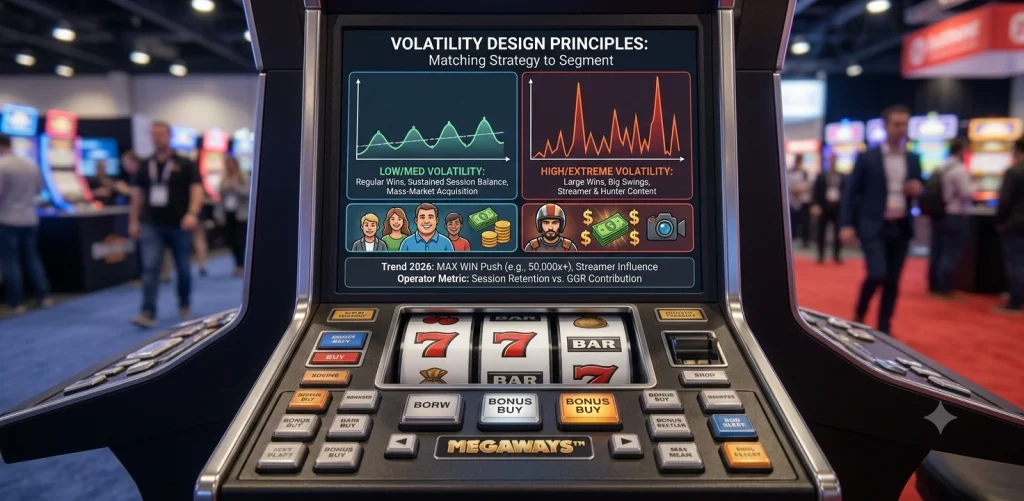
Volatility describes the distribution of outcomes around the RTP mean. A low-volatility game pays frequently but in small amounts, keeping the session bankroll relatively stable. A high-volatility game pays rarely but in large amounts, creating long dry spells punctuated by significant wins. Extreme-volatility titles, which dominate the 2026 release calendar, can go hundreds of spins without a meaningful return before delivering wins of 5,000x or more.
The Four Volatility Tiers and Their Commercial Use Cases
The industry broadly uses four tiers, though some studios add a fifth “extreme” classification for titles with max wins above 20,000x:
| Volatility Tier | Hit Frequency | Typical Max Win | Win Distribution | Primary Player Segment |
| Low | 35–50% of spins | 500–1,000x | Frequent small wins | Casual, recreational, lower-budget sessions |
| Medium | 20–35% of spins | 1,000–5,000x | Balanced, moderate peaks | Broad audience; lobby anchor titles |
| High | 10–20% of spins | 5,000–20,000x | Infrequent, large peaks | Experienced players, streamers, bonus hunters |
| Extreme | Under 10% of spins | 20,000–100,000x+ | Rare, massive peaks | High-rollers, crypto operators, streamer content |
Matching Volatility to Operator Objectives
The volatility decision is not just a product choice; it is a portfolio strategy. Operators with a broad player base need a mix across tiers. Operators targeting high-value players in less regulated markets may weight their lobby toward high and extreme titles.
For studios, the critical insight is that volatility tier should be determined by the target operator and market before the math model is built, not after. Retrofitting a high-volatility math model into a game designed around low-volatility session pacing creates incoherence between the visual language and the player experience.
The 2026 trend is clear: as iGaming Wheel’s 2026 release analysis notes, extreme-volatility titles now dominate the upper tier of new releases, with max wins pushing past 50,000x on flagship titles. Bonus Buy variants ship standard on nearly every extreme-volatility release. The math gets harder for players to intuit, but produces the wide outcome distribution that streamers and high-rollers demand.
Volatility and Retention: The Operator’s Real Concern
Operators often conflate high RTP with player retention. The data tells a different story. Low-to-medium volatility titles typically drive longer session times and higher revisit rates among recreational players. High-volatility titles produce higher average bet sizes and shorter sessions, but the players who seek them out are disproportionately valuable by GGR contribution.
The implication for full-cycle game development is that volatility design must be aligned with the operator’s player acquisition strategy from the outset. A studio building a title for a mass-market UK operator needs a different volatility profile than one building for a Curaçao-licensed crypto casino.
Bonus Buy Mechanics: How They Work and Where They Are Banned
Bonus buy, also called feature buy or bonus purchase, allows players to pay a fixed multiple of their stake (typically 50x to 100x) to immediately trigger the game’s bonus round, bypassing the base game entirely. From a math design perspective, it is an elegant mechanism: the player pays a premium to access the high-variance, high-return portion of the math model on demand.
From a regulatory perspective, it is one of the most contested mechanics in modern slot design.
How Bonus Buy Affects the Math Model
A bonus buy option is not simply a shortcut to the free spins round. It requires a separate, certified math calculation. The purchase price must be set such that the expected value of the bonus round equals the cost of the buy option, adjusted for the studio’s margin. In practice, this means:
- The bonus buy RTP is typically higher than the base game RTP (often 96–97% on titles where the base game runs at 94–95%)
- The PAR sheet must document the bonus buy expected value separately from the base game
- Certification labs test the bonus buy path as a distinct mathematical sequence
- Each jurisdiction-specific RTP variant requires a separately certified bonus buy calculation
The commercial logic is straightforward: bonus buy converts the high-volatility portion of the math model into a premium product. Players who want the streamer-style big-win experience without grinding through the base game will pay for direct access. For operators, bonus buy titles drive higher average bet sizes and shorter sessions from a specific high-value player segment.
Regulatory Status by Jurisdiction
The bonus buy landscape has bifurcated sharply since 2019, and studios building for multi-market distribution must now maintain separate game variants:
| Jurisdiction | Bonus Buy Status | Notes |
| United Kingdom (UKGC) | Banned | Prohibited since 2019; confirmed under 2025-2026 regulatory overhaul |
| Sweden (Spelinspektionen) | Restricted | Effectively limited; responsible gambling framework discourages it |
| Netherlands (KSA) | Permitted with conditions | Operators must implement responsible gambling tools |
| Malta (MGA) | Permitted | No prohibition; standard practice for MGA-licensed operators |
| Gibraltar | Permitted | Broadly follows UK direction but no formal ban |
| Curaçao | Permitted | No restrictions; standard in crypto-native catalogue |
| Ontario (iGO) | Permitted | Regulated market with no bonus buy prohibition |
The UK Gambling Commission’s position is unambiguous: bonus buy is banned under the broader package of slot game design restrictions introduced as part of the 2023 White Paper implementation. The UKGC’s rationale is that bonus buy enables players to escalate their spending rapidly and bypasses the natural pacing of the base game.
The Dual-Variant Production Model
The practical consequence for studios is a dual-variant production model. A title targeting both UK and MGA markets ships as two certified games:
- The “buy” variant: includes the bonus buy option, certified for MGA, Curaçao, and other permissive markets
- The “no-buy” variant: removes the purchase mechanic, adjusts the base game math to compensate, and is certified for UKGC submission
The base game math adjustment in the no-buy variant is critical and often underestimated. Simply removing the bonus buy button from a game designed around it creates a title where the base game feels unrewarding. Studios need to redesign the base game trigger frequency and payout distribution for the no-buy variant, which functionally means building two different math models that share a visual and feature framework.
Key insight: According to iGaming Wheel’s 2026 release analysis, regulatory bifurcation is one of the three defining trends shaping the 2026 release calendar. “UK and several European markets have removed or limited Bonus Buy, prompting studios to ship two variants: a ‘buy’ version for unregulated markets, a ‘no-buy’ version with adjusted base game math for regulated ones.”
MEGAWAYS and Cluster Pays: Architecture, Licensing, and Design Implications
The two most influential reel architecture innovations of the past decade are MEGAWAYS and cluster pays. Both represent fundamental departures from the fixed-payline model that dominated slot design for the first two decades of online gaming. Both create high-volatility math profiles by design. And both carry specific licensing, certification, and production implications that studios must understand before committing to either architecture.
MEGAWAYS: How the Mechanic Works
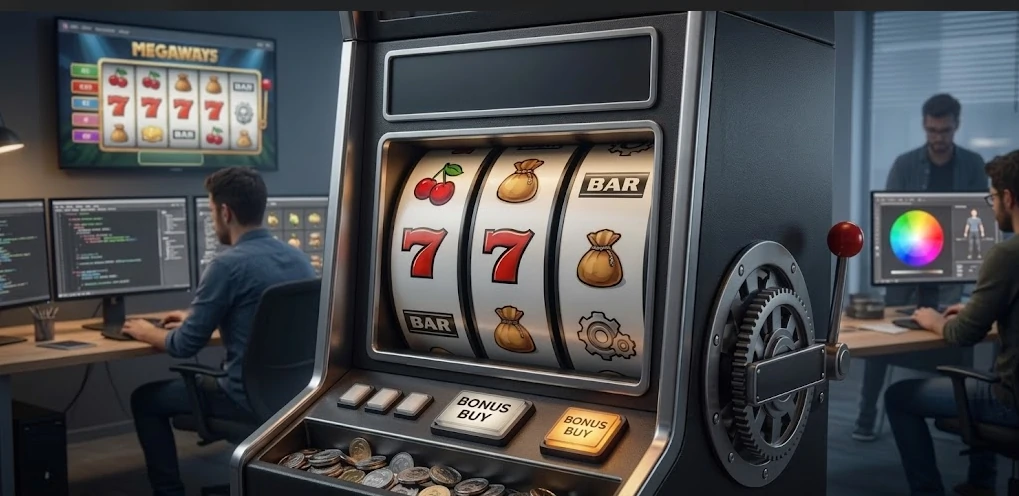
MEGAWAYS is a patented reel modifier mechanic developed by Big Time Gaming. First deployed in Dragon Born in 2016 and popularised through Bonanza, the mechanic works by randomising the number of symbols displayed on each reel with every spin.
In a standard 5×3 slot, the number of ways to win is fixed at 243. A six-reel MEGAWAYS implementation displays anywhere from 2 to 7 symbols per reel simultaneously, generating up to 117,649 ways to win on any given spin. The number of active ways changes dynamically with each spin, creating an outcome space orders of magnitude larger than any fixed-reel equivalent.
The mathematical consequence is structural high volatility. When each reel shows only 2 symbols (the minimum), the number of active ways collapses to a few hundred. When all reels show 7 symbols, 117,649 ways are active simultaneously. This asymmetry, frequent low-way-count spins producing minimal returns punctuated by occasional maximum-way-count spins with enormous win potential, is the mathematical definition of extreme volatility.
The majority of MEGAWAYS titles compound this with a cascade (also called avalanche or tumble) mechanic: winning symbols are removed and replaced by new symbols from above, with each cascade potentially generating a new MEGAWAYS configuration. This is the source of the very large single-spin GGR outcomes that make MEGAWAYS titles disproportionately represented in high-value win events.
MEGAWAYS Licensing: What Studios Need to Know
Big Time Gaming holds the patent on the MEGAWAYS mechanic. BTG was acquired by Evolution in 2021, meaning the patent is now an asset within the Evolution group. Studios that want to build MEGAWAYS titles must license the mechanic from BTG directly.
Key licensing considerations:
- Royalty structure: BTG charges a royalty per title or per GGR; the specific terms are not publicly disclosed but licensing fees are a significant cost in the production budget
- Certification: MEGAWAYS titles require separate certification that covers the variable reel height mechanic; the PAR sheet must document all possible ways-to-win configurations
- Operator transparency: when an operator acquires a MEGAWAYS title from a licensed studio (Pragmatic Play, Red Tiger, Blueprint Gaming, etc.), the MEGAWAYS royalty is embedded in the studio’s commercial structure; operators do not negotiate separately for MEGAWAYS access
- Alternatives: BTG has extended the licensing programme to include Megapays and Megaclusters variants; studios with an existing MEGAWAYS licence can add these at reduced cost
For studios evaluating whether to license MEGAWAYS or develop a proprietary variable-reel mechanic, the honest answer is that MEGAWAYS carries significant brand recognition with players. Titles using the mechanic benefit from the player trust built by Bonanza, Extra Chilli, and the broader licensed catalogue. A proprietary variable-reel mechanic requires building that recognition from scratch.
Cluster Pays: A Different Architecture, Similar Outcomes
Cluster pays replaces the payline or ways-to-win model entirely with adjacency-based wins. A cluster pay game awards wins when a defined number of matching symbols appear in adjacent positions (horizontally and vertically) on the grid. The minimum cluster size is typically 5 symbols; larger clusters pay proportionally more.
The commercial appeal of cluster pays for studios is significant:
- No licensing cost: unlike MEGAWAYS, cluster pays is not a patented mechanic; any studio can implement it
- Grid flexibility: cluster games typically use a 5×5, 6×6, or 7×7 grid, giving designers more canvas space than a 5×3 reel layout
- Cascade compatibility: cluster pays grids pair naturally with cascade mechanics, where winning clusters are removed and new symbols fall in, potentially creating chain reactions
- Volatility control: cluster pay math models can be tuned across a wide volatility range, from medium (frequent small clusters) to extreme (rare massive clusters with multipliers)
Multi-Mechanic Stacking: The 2026 Design Pattern
The dominant design pattern in 2026 is multi-mechanic stacking: modern flagship titles layer three or four distinct mechanics into a single bonus round. A typical configuration might combine cluster pays with a tumble mechanic, multiplier reels, and sticky symbols. The math complexity increases significantly, but the outcome distribution produces the wide variance that streamers and high-rollers demand.
As BGaming’s 2026 iGaming trends analysis notes, “volatile models, bonus-buy mechanics, cluster pays, and MEGAWAYS-style reel structures continue to shape how modern releases are designed and positioned.” The differentiation pressure is driving studios toward increasingly complex math architectures to stand out in an oversaturated content market.
The risk studios underestimate: multi-mechanic stacking creates certification complexity that scales non-linearly with the number of mechanics. Each interaction between mechanics (e.g., does a multiplier apply before or after the cluster pay calculation? Does a cascade reset the multiplier?) must be precisely documented in the GDD and PAR sheet, and tested by the certification lab. Poorly documented mechanic interactions are one of the most common causes of certification delays and resubmissions.
The psychology of how game mechanics affect player behaviour is directly tied to these architectural choices: cluster pays grids with cascades create a sense of continuous action, while MEGAWAYS titles create tension through the variable ways display. Both are deliberate math design decisions, not incidental features.
Math Model Testing and Certification: What the Labs Actually Require
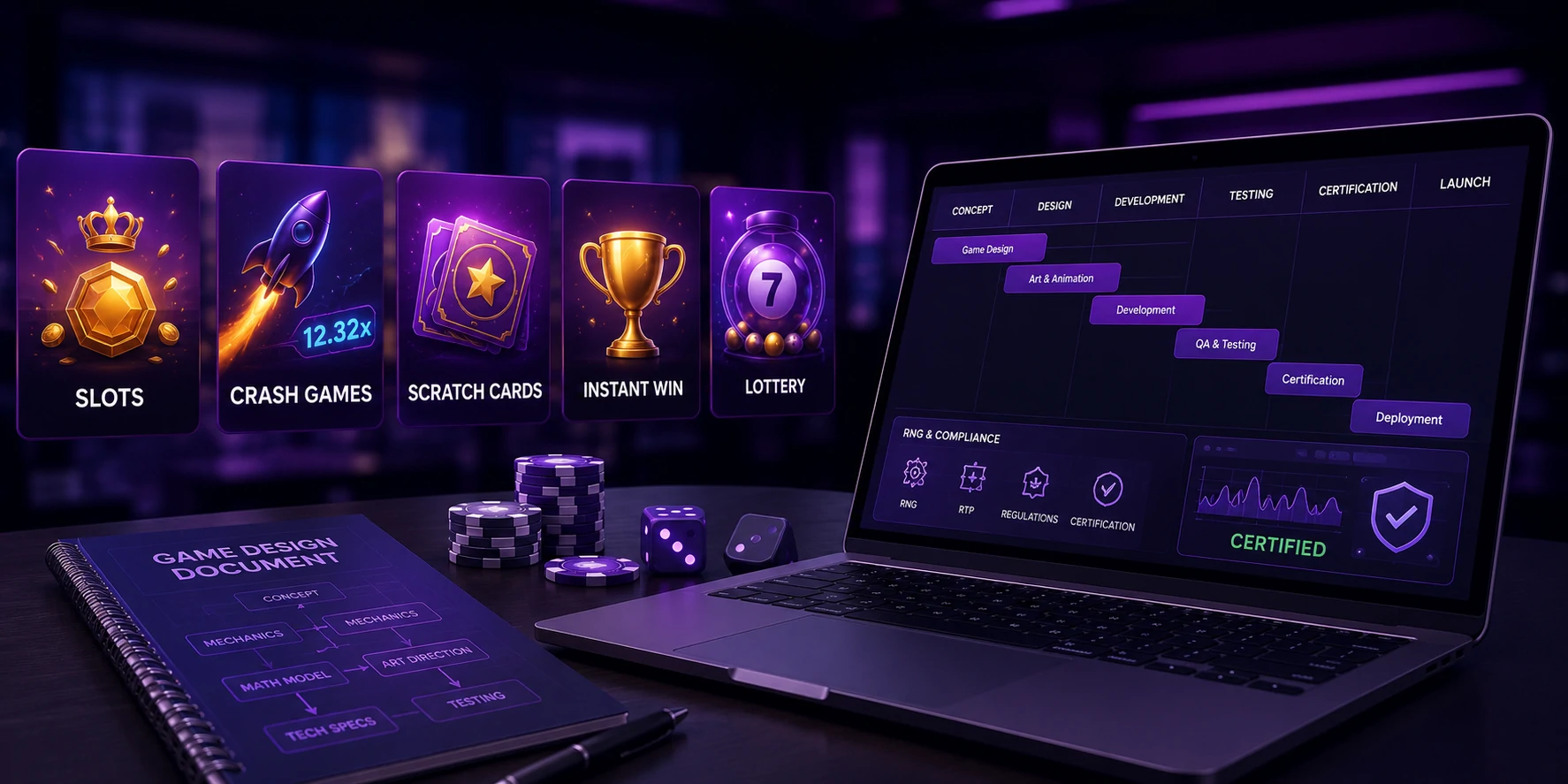
Certification is where math design decisions become legally binding. A certified math model is not just a document; it is the contractual specification of how the game must behave in production. Any divergence between the certified math and the running code is a compliance failure, regardless of whether it was intentional.
Understanding what certification labs require, and why they require it, allows studios to build certification-ready documentation from the start rather than retrofitting it at the end of production.
The Primary Certification Bodies
Three labs handle the majority of online slot certifications for regulated markets:
| Lab | Primary Markets | Key Standard | Notes |
| Gaming Laboratories International (GLI) | Global | GLI-11 (RNG), GLI-16 (online games) | The dominant global standard; required by most regulated jurisdictions |
| iTech Labs | MGA, Australia, global | Malta Remote Gaming Regulations | Strong MGA presence; partnership with GLI for cross-jurisdiction coverage |
| BMM Testlabs | North America, Australia | Jurisdiction-specific | Required for several North American markets |
| eCOGRA | Soft certification | Requires GLI or iTech certificate as prerequisite | Used for platform-level trust marks, not primary game certification |
For studios targeting UK and MGA markets, GLI and iTech Labs are the practical choices. eCOGRA certification is an additional layer that some operators require, but it builds on a primary lab certificate rather than replacing it.
The Technical Submission Package
What certification labs actually receive is a Technical Submission Package (TSP). The components that most commonly cause delays or rejections are:
1. The PAR Sheet (Probability Accounting Report) The PAR sheet is the complete mathematical documentation of the game. It must cover every winning combination with exact payouts, all bonus feature calculations (including bonus buy paths if applicable), wild substitution rules with all edge cases, scatter rules and trigger conditions, and the RTP calculation broken down by contribution from each feature.
A common failure: studios document the base game PAR sheet thoroughly but treat the bonus round as a single line item. Certification labs require the full mathematical breakdown of every feature, including how mechanics interact.
2. RNG Documentation The RNG algorithm must be precisely specified, including the seeding strategy and entropy sources. For GLI-11 certification, the lab runs the full NIST SP 800-22 test suite on RNG output: 15 statistical tests across 100 sequences of one million bits each, with a 99% confidence threshold. Using System.Random or any time-based seeding will fail immediately. Seeds must derive entirely from an OS-level cryptographically secure pseudorandom number generator (CSPRNG).
3. Simulation Data The lab runs large-scale simulations against the certified math model to verify that the game’s actual behaviour matches the PAR sheet. The standard tolerance is:
- No single 1M-spin run deviating by more than 2% from documented RTP
- The mean across three 1M-spin runs deviating by no more than 0.5%
- Specific combination hit frequencies verified against PAR sheet values
4. Audit Log Specification Every field logged per spin must be documented in enough detail to fully reconstruct any historical spin. This is not just a technical requirement; it is the mechanism by which regulators investigate player complaints and verify operator compliance.
The “Certified Math vs. Game Math” Problem
The most consequential certification concept for studios to internalise is the distinction between certified math and game math. Certified math is the mathematical model that was submitted to and approved by the lab. Game math is what the running code actually computes.
These must be identical. Not approximately identical. Identical.
The most common source of divergence is post-certification changes. A studio fixes a bug, adjusts a payout table for balance reasons, or modifies a feature interaction. If that change is not submitted to the lab and re-certified, the game is operating outside its certified specification. This is a compliance failure that can result in the game being pulled from operator platforms.
The practical rule: any change to game logic, payout tables, feature mechanics, or RNG implementation after initial certification requires a lab resubmission. Minor changes may qualify for a certificate addendum rather than a full re-certification, but the lab determines that, not the studio.
Certification Timelines and What Delays Them
Studios building certification into their production timeline need realistic estimates. For a standard online slot:
- Initial submission to certificate: 6 to 12 weeks for a well-documented submission
- Resubmission after findings: adds 3 to 6 weeks per round of findings
The most common causes of certification delay are incomplete PAR sheet documentation (especially bonus feature interactions), RNG seeding issues identified in the NIST test suite, discrepancies between the GDD and actual game behaviour, and missing audit log fields.
Studios working with experienced math designers who have prior certification submissions on record can reduce submission preparation time significantly. This is one of the strongest arguments for full-cycle game development partnerships with studios that have existing certification relationships with the major labs.
Math Differentiation as a Competitive Strategy in 2026
The content market is saturated. Pragmatic Play alone is on track to release 60+ titles in 2026. Hacksaw, Nolimit City, and BGaming are each shipping 25 to 40 titles. In a market where operators can choose from thousands of certified titles, the question for studios is no longer “can we build a slot?” but “what makes this slot worth adding to a lobby already full of slots?”
The answer, increasingly, is math differentiation.
BGaming’s 2026 iGaming trends report identifies math differentiation explicitly as one of the primary drivers of content positioning. “Social-inspired mechanics, branded content, and stronger visual identity are also becoming more common as providers look for clearer differentiation.” The studios gaining shelf space are those with a recognisable math signature: a distinctive volatility profile, a proprietary mechanic, or a feature architecture that players associate with a specific experience.
What Math Differentiation Actually Looks Like in Practice
Math differentiation is not about being different for its own sake. It is about building a math model that serves a specific player segment better than the alternatives, and being consistent enough about it that operators and players know what to expect from your catalogue.
Three approaches are generating the strongest results in 2026:
1. Proprietary mechanic development Rather than licensing MEGAWAYS, studios are investing in developing their own variable-reel or grid mechanics. The upfront cost is higher, but a successful proprietary mechanic builds catalogue-level brand equity rather than contributing royalties to another studio’s IP.
2. Extreme max-win positioning A cohort of studios has staked their identity on max-win potential: titles with 50,000x, 100,000x, or higher theoretical maximums. This positions them specifically for streamer audiences and high-value crypto players. The math challenge is building a model where the extreme max win is achievable through a genuine (if rare) game path rather than a theoretical construct that never triggers in practice.
3. Liveops-integrated math The convergence of slot math design with liveops game development is an emerging frontier. Studios are building math models that can be adjusted post-launch within certified parameters: RTP variants activated for specific promotional periods, volatility profiles surfaced differently based on player segment data, and feature frequencies tuned in response to retention analytics. This requires certification frameworks that anticipate post-launch adjustment rather than treating the certified model as static.
The Slot Game Design Decision Tree
For operators and studio leads evaluating a new title, the math design decisions flow in a specific order:
- Target market(s): Which jurisdictions? This determines RTP floor and bonus buy availability
- Player segment: Casual, recreational, or high-value? This determines volatility tier
- Mechanic architecture: Paylines, ways-to-win, MEGAWAYS, or cluster pays? This determines the structural volatility profile and any licensing costs
- Bonus buy variant: Is the target market permissive? If yes, build the buy variant; if regulated (UK), plan the no-buy math model separately
- Max win target: What is the headline max win? This constrains the entire distribution design
- Certification market: Which lab? This determines the documentation standard and submission requirements
Every decision in this sequence constrains the decisions that follow. Studios that try to work backwards from a visual concept to a math model consistently produce titles that feel incoherent or fail certification. The math model is the brief; everything else is execution.
Frequently Asked Questions
What is a good RTP for a slot game?
“Good” depends entirely on the target market and player segment. For UK-licensed operators, the UKGC requires a minimum of 94% RTP; industry practice for competitive titles targets 94–96%. For MGA-licensed operators, the floor is 92%, though most competitive titles still target 94%+. For crypto-native operators on Curaçao licences, there is no regulatory floor, but player expectations in that market typically align with 96%+ for high-volatility titles. The real question is not what is “good” in the abstract but what RTP your target operator’s player base expects and what your margin requirements allow.
What is the difference between RTP and volatility?
RTP is the long-run return percentage across millions of spins. Volatility describes how that return is distributed across individual sessions. Two games can share a 96% RTP: one pays back 96p for every £1 wagered in small, frequent wins (low volatility); the other pays nothing for 200 spins and then delivers a 5,000x win (high volatility). Both return 96% over time. The player experience, the session bankroll requirement, and the player segment they attract are entirely different. RTP is a compliance parameter; volatility is a product design decision.
Is bonus buy banned in the UK?
Yes. The UK Gambling Commission banned bonus buy (also called feature buy) in 2019 as part of its responsible gambling framework. The ban was reaffirmed and extended under the 2025–2026 regulatory overhaul implementing the 2023 White Paper. UK-licensed operators cannot offer titles with bonus buy functionality. Studios targeting UK distribution must build a separate no-buy variant with adjusted base game math. Other markets, including MGA-licensed operators in Malta and Curaçao-licensed operators, permit bonus buy without restriction.
How does MEGAWAYS create high volatility?
MEGAWAYS creates structural high volatility through its variable reel height mechanic. On any given spin, each reel displays between 2 and 7 symbols, generating anywhere from a few hundred to 117,649 ways to win. Spins with low reel heights produce few or no wins; spins with maximum reel heights across all six reels create enormous win potential across hundreds of thousands of simultaneous ways. This asymmetry, combined with the cascade mechanic present in most MEGAWAYS titles, produces the extreme volatility profile that defines the mechanic. It is not a tunable parameter; it is an architectural consequence of how the mechanic works.
Do I need a licence to use MEGAWAYS in my slot?
Yes. MEGAWAYS is a patented mechanic owned by Big Time Gaming (BTG), which was acquired by Evolution in 2021. Studios wishing to develop MEGAWAYS titles must license the mechanic from BTG. The royalty structure is not publicly disclosed but represents a significant cost in the production budget. Studios that want the variable-reel architecture without the licensing cost should develop a proprietary mechanic; several studios have done this successfully, though building player recognition for a new mechanic takes time and catalogue depth.
What does a certification lab actually test?
Certification labs test the complete Technical Submission Package, which includes the PAR sheet (full mathematical documentation of every game feature), RNG documentation (algorithm specification, seeding strategy, statistical test results), simulation data (large-scale spin simulations verifying that actual game behaviour matches the PAR sheet), audit log specification, and source code or test environment access. The RNG is tested against the NIST SP 800-22 test suite under GLI-11 standards. The mathematical review verifies that no single 1M-spin run deviates by more than 2% from documented RTP, and that the mean across three 1M-spin runs deviates by no more than 0.5%.
How long does slot certification take?
For a well-documented submission to a primary lab (GLI or iTech Labs), expect 6 to 12 weeks from submission to certificate. Each round of findings and resubmission adds 3 to 6 weeks. The most common causes of delay are incomplete PAR sheet documentation, RNG seeding issues, discrepancies between the Game Description Document and actual game behaviour, and missing audit log fields. Studios that build certification-ready documentation from the start of math design, rather than treating it as a post-development task, consistently achieve shorter timelines.
What is the difference between cluster pays and MEGAWAYS?
Cluster pays and MEGAWAYS are both alternatives to the traditional fixed-payline model, but they work differently. MEGAWAYS is a variable-reel mechanic that randomises the number of symbols per reel each spin, creating up to 117,649 ways to win on a six-reel game. Cluster pays removes paylines entirely and awards wins based on groups of matching symbols appearing in adjacent positions on a grid (typically 5×5 to 7×7). Cluster pays is not a patented mechanic, so any studio can implement it without licensing costs. Both architectures pair naturally with cascade mechanics and both tend toward high volatility, though cluster pay math models can be tuned across a wider volatility range than MEGAWAYS.