
Crash Game Development: How to Build, Certify, and Launch a Provably Fair Crash Game
Crash games are the fastest-growing casino format in 2026, and building one requires provably fair RNG architecture, real-time multiplier logic, and jurisdiction-specific certification. That combination makes crash game development fundamentally different from slot or table game production. The engineering profile is more demanding, the certification path is less standardised, and the operator integration requirements are stricter, because every round runs as a synchronised event across thousands of concurrent players with cashout windows measured in milliseconds.
The market context: crash titles now account for a significant share of originals traffic on major aggregator networks, driven by the format’s social mechanics, high RTP (typically 96–97%, with market leaders Aviator and JetX both sitting at 97%), and appeal to both fiat and crypto player segments. Operators who do not carry at least one proprietary or co-developed crash title are increasingly at a content disadvantage.
This guide covers every stage of the development process: technical architecture, UI/UX design requirements, the certification pathway through GLI and iTech Labs, operator integration via Remote Gaming Server (RGS) or direct API, a realistic build timeline, and what the investment looks like from concept to live ops. It is written for operators, platform owners, and aggregators who are evaluating crash game development studios or considering co-development for the first time.
What Makes Crash Games Technically Distinct
Most casino content is single-player by design. A slot resolves one session for one player; the server handles the round, returns a result, and closes the transaction. Crash is architecturally the opposite: every round is a shared, real-time event, and the server must synchronise game state across all connected clients simultaneously.
That distinction has direct engineering consequences across four layers of the stack.
| Layer | Slot / Table Game | Crash Game |
| Session model | Single-player, asynchronous | Multiplayer, synchronous |
| RNG timing | Generated per-spin, post-bet | Pre-committed before betting opens |
| Latency tolerance | 200–500ms acceptable | Sub-100ms required for cashout |
| Concurrency risk | Low (session isolation) | High (shared round state) |
The real-time multiplier is the core mechanic. A curve function grows the multiplier from 1.00x at round start, and the server crashes it at a pre-determined point derived from the RNG output. Players must cash out before the crash. The cashout window can be as short as a few hundred milliseconds, which means any server-side lag or client rendering delay is immediately visible and immediately damaging to player trust.
The part most coverage misses: the multiplayer backend is the highest-risk technical component in crash game development, not the RNG. Studios without prior real-time multiplayer infrastructure experience consistently underestimate this layer and deliver backends that begin to degrade under higher concurrent player loads. The RNG mathematics are well-documented; the concurrency engineering is where projects fail.
Technical Architecture: Client-Server Model and RNG Implementation
A production-ready crash game is built on two tightly coupled systems: a real-time multiplayer server and a provably fair RNG. Getting either wrong produces a game that either fails under load or fails under scrutiny.
The Client-Server Model
The server is the single source of truth for every round. The architecture follows a WebSocket-based pub/sub model:
- Pre-round phase: The server generates the crash point using the RNG, commits the result via a cryptographic hash, and broadcasts the hash to all connected clients before betting opens.
- Betting phase: Players submit bets. The server validates each bet server-side and locks the round when the countdown ends.
- Active phase: The server broadcasts multiplier updates at a fixed tick rate. Clients render the curve locally between ticks to maintain smooth animation.
- Cashout handling: Cashout requests are validated server-side in real time. The server timestamps the request and confirms the cashout at the multiplier value at the moment of receipt, not at the moment of client render.
- Crash and reveal: The round ends when the multiplier reaches the pre-committed crash point. The server reveals the seed, and players can independently verify the outcome.
Critical design rule: cashout validation must happen server-side. Any client-side cashout logic creates a manipulation surface and will fail certification review.
Provably Fair RNG: The Hash Chain
The standard for multiplayer crash games is a SHA-256 reverse hash chain, the same approach used by established crypto platforms. The mechanics work as follows:
- A master seed is generated using a cryptographically secure pseudorandom number generator (CSPRNG), per NIST SP 800-90A Rev.1 standards.
- The master seed is hashed up to 10 million times. The final hash is used for Round 1; the second-to-last hash for Round 2, and so on. This creates a verifiable timeline: any player can hash Round 50’s seed to confirm it matches Round 49’s committed value.
- The terminating hash (the last in the chain) is published publicly before a single round is played. Because each link is the SHA-256 pre-image of the next, that single published hash cryptographically commits to every future round in the chain.
- The crash multiplier for each round is derived from HMAC-SHA256(gameSeed, salt), where the salt is an external entropy value that did not exist when the terminating hash was published, removing any possibility of operator foreknowledge. On crypto-oriented platforms, this salt is typically the hash of a future Bitcoin block. For regulated fiat markets (UKGC, MGA), the external entropy source must be agreed with the certification lab before development begins, as some jurisdictions require the entropy source itself to be documented and approved as part of the RNG submission.
Multiplier Formula and House Edge
Crash games use a provably fair mathematical model to convert cryptographic inputs into a deterministic crash multiplier. While the exact implementation varies between providers, the underlying principles remain consistent: the outcome must be reproducible, verifiable, and impossible to manipulate after bets have been placed.
The house edge is built into the game’s mathematical model and determines the long-term RTP. Most regulated crash games target an RTP of approximately 96–97%, balancing regulatory compliance, player retention, and commercial performance.
What this means for operators: the mathematical model becomes part of the certified game logic. Once certified, any changes that affect RTP or game mathematics typically require revalidation by the testing laboratory before deployment.
UI/UX Requirements for Crash Games
The player experience in a crash game is largely defined by three interface elements: the multiplier counter, the crash animation, and the cashout button. All three should respond instantly from the player’s perspective, with immediate visual feedback and minimal perceived latency. Even small delays in cashout confirmation can disrupt the real-time experience and reduce player trust in the game’s responsiveness.
Mobile-First Design Constraints
Crash games are predominantly played on mobile. Design must begin at 390px portrait width, with all interactive elements sized for thumb reach. Key requirements:
- Cashout button: minimum 44px tap target, positioned within the natural thumb zone, with immediate visual feedback on press (colour change or animation within 16ms)
- Multiplier counter: large, high-contrast typography, legible at a glance without requiring the player to focus on the screen
- Crash animation: should target smooth animation (typically up to 60fps where supported) with graceful degradation on lower-end devices; noticeable frame drops during the active phase can reduce player trust.
- Bet history panel: accessible without leaving the game view; players use this to verify past rounds against the provably fair calculator
Social Layer and Live Feed
The social mechanics are a significant driver of crash game engagement. A live player feed showing other participants’ bets, cashouts, and multipliers creates the shared-stakes atmosphere that distinguishes the format from single-player content. This layer requires careful UX design to avoid information overload while preserving the social signal.
Key takeaway: the live feed is not cosmetic. It is the primary mechanism through which players calibrate their own cashout timing, which directly affects session length and bet frequency. Removing or hiding it to simplify the UI will reduce engagement metrics.
Responsible Gambling UI
For regulated markets, responsible gambling features are not optional additions. They are certification requirements. The UI must accommodate:
- Session time and loss limit displays, accessible within two taps from the game view
- Reality check prompts at configurable intervals
- Self-exclusion links that do not require navigating away from the game
- Clear RTP disclosure, typically displayed in the game info panel
These requirements differ by jurisdiction. The UK Gambling Commission’s remote technical standards are among the most prescriptive; Malta Gaming Authority and Curaçao have different (and in some cases less stringent) requirements. The target regulatory environment must be confirmed before UI design begins, as retrofitting responsible gambling features after build completion adds significant rework cost.
Certification Path: GLI-19, iTech Labs, and What Labs Actually Test
Certification is the stage most operators underestimate in terms of both timeline and preparation requirements. Labs do not simply run the game and check whether it works. They audit the entire system: RNG entropy source, outcome determinism, operator control surfaces, software integrity mechanisms, and responsible gambling tooling.
The Two Primary Lab Paths
Gaming Laboratories International (GLI) is the dominant certification body for regulated fiat markets. For online crash games, the relevant standard is GLI-19 (Interactive Gaming Systems), which covers:
- RNG entropy documentation (source must comply with NIST SP 800-90A Rev.1)
- Deterministic reproducibility: every outcome must be reproducible from committed inputs
- Software integrity: the system must verify all critical control programme components at least once every 24 hours using a cryptographic hash algorithm producing a minimum 128-bit digest
- Absence of post-hoc operator control: no mechanism may allow the operator to alter an outcome after the round begins
- Third-party verification procedure: each critical component must be verifiable by an independent process operating outside the game system
iTech Labs is widely used for MGA, Curaçao, and a range of emerging market jurisdictions. Their process is fixed-price and milestone-based, with weekly or bi-weekly progress reports during testing. iTech Labs provides three certification tiers relevant to crash games: RNG certification, RNG and Game certification (combined), and RTP/RNG audit certification (from live server logs). For most operators, RNG and Game certification is the minimum viable credential.
What Labs Actually Look For
Certification labs evaluate three things that the provably fair hash chain architecture already provides, provided it is implemented correctly and documented thoroughly:
- Documented entropy source: the CSPRNG used to generate the master seed must be identified, and its compliance with NIST SP 800-90A Rev.1 stated explicitly in the submission documentation.
- Deterministic reproducibility: every round must be a pure function of committed inputs. Labs will attempt to reproduce outcomes from provided seeds; any discrepancy fails the submission.
- No operator foreknowledge or post-round control: the future Bitcoin block salt mechanism removes foreknowledge; server-side cashout validation removes post-round control. Both must be documented and demonstrable.
Common Submission Failures
The single most common reason for certification delays is insufficient documentation, not defective code.
Labs require source code, math model documentation, RNG test programmes, and a complete description of the game mechanics before testing begins. Submissions that arrive with incomplete documentation are returned, restarting the queue. Build documentation in parallel with development, not after it.
Jurisdiction-Specific Considerations
| Jurisdiction | Relevant Standard | Lab Commonly Used |
| United Kingdom | UKGC Remote Technical Standards | GLI, eCOGRA |
| Malta (MGA) | MGA Technical Standards | GLI, iTech Labs |
| Curaçao | eGaming Regulations | iTech Labs, BMM |
| Gibraltar | Licensing Authority Standards | GLI |
| Kahnawake | Gaming Commission Standards | GLI, iTech Labs |
Operators targeting multiple jurisdictions should plan for sequential or parallel certification submissions. A game certified under GLI-19 for one jurisdiction is not automatically accepted in another; each regulator maintains its own approved lab list and may require additional jurisdiction-specific testing.
Operator Integration: RGS, API Architecture, and Go-Live Requirements
A finished and certified crash game is not ready to distribute until it integrates with the operator’s platform. This stage is often treated as a formality; in practice, it is a distinct engineering workstream with its own QA cycle.
How RGS Integration Works
A Remote Gaming Server (RGS) sits between the game engine and the operator’s casino platform. It handles wallet communication, session management, bet settlement, reporting, and bonus engine connectivity through a single integration point. For operators, an RGS means one connection gives access to the full game portfolio with consistent reporting and compliance tooling across all titles.
The standard integration flow for a crash game via RGS:
- API onboarding: the operator completes a one-time integration against the RGS API, typically REST or WebSocket over HTTPS with JSON payloads
- Player authentication: session tokens are issued by the operator’s platform and validated by the RGS on each game launch request
- Wallet configuration: debit (bet) and credit (win) calls are routed through the RGS to the operator’s wallet; idempotency keys on each transaction prevent double-settlement in the event of a retried call
- Game launch URL: the RGS returns a signed launch URL containing the session token, player currency, and game parameters; the HTML5 client loads in an iframe or WebView
- Reporting and reconciliation: round-level transaction data is available via the RGS back-office; operators can pull session reports, RTP audits, and player history
The idempotency requirement is non-negotiable. A retried HTTP call or a worker that processes the same message twice must never settle a bet twice. Settlement tables must be keyed on a unique bet_id with conflict handling that silently ignores duplicate submissions. This is a common source of live-ops incidents in studios that build crash games without prior RGS experience.
Direct API Integration
For operators with proprietary casino platforms, direct API integration bypasses the RGS layer. The game studio exposes its own game server API, and the operator integrates directly. This approach offers more flexibility in wallet logic and bonus mechanics but requires the operator’s technical team to manage the integration, and it places certification and compliance responsibility on the studio’s server infrastructure rather than a third-party RGS.
Direct integration is typically used by large operators building a proprietary crash title under their own brand, or by platforms that already operate their own RGS and want to add a co-developed crash game to their existing content pipeline.
Aggregator Distribution
For studios distributing a crash game across multiple operators simultaneously, aggregator SDK compatibility is essential. Major aggregation platforms accept HTML5 games delivered via a standardised launch URL and API contract. The game must pass the aggregator’s own technical review (separate from lab certification) before it appears in the aggregator’s catalogue.
Key takeaway: plan for three distinct integration workstreams: RGS or direct API integration for the first operator, aggregator SDK compatibility for multi-operator distribution, and a separate QA cycle for each new operator’s wallet and bonus engine configuration.
Build Timeline: What 12 to 20 Weeks Actually Covers
A realistic crash game development timeline for a studio with existing real-time multiplayer infrastructure runs 12 to 20 weeks from concept sign-off to live deployment. Studios building their first crash game, or those without prior RGS integration experience, should plan for the upper end of that range or beyond.
The timeline below reflects a full-cycle engagement covering math model, server, HTML5 client, QA, certification submission, and operator integration.
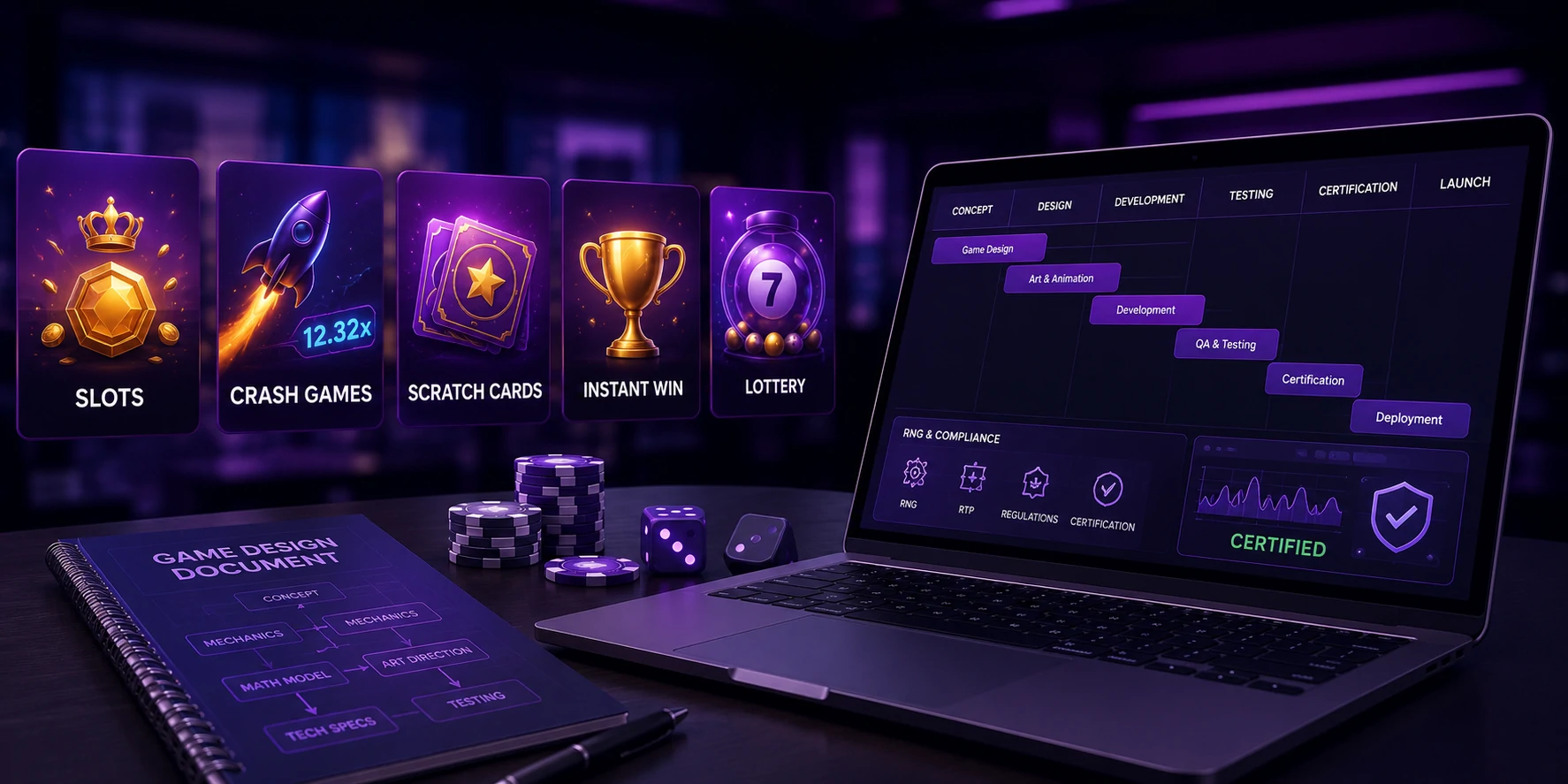
Phase Breakdown
| Phase | Duration | Key Deliverables |
| Discovery and math design | Weeks 1–2 | Multiplier curve specification, RTP model, house edge confirmation, regulatory target confirmed |
| RNG and server architecture | Weeks 3–5 | Hash chain implementation, WebSocket server, concurrency load model, cashout validation logic |
| HTML5 client development | Weeks 4–8 | Multiplier counter, crash animation, cashout UI, bet history, mobile-first responsive layout |
| QA and load testing | Weeks 8–12 | RNG statistical validation (minimum 1 million simulated rounds), concurrent session load test at 2x expected peak, cashout edge cases |
| Certification submission | Weeks 10–16 | Source code, math documentation, RNG test programme submitted to GLI or iTech Labs; lab review and bug fix cycle |
| Operator integration | Weeks 14–18 | RGS API onboarding, wallet configuration, session testing, back-office reporting validation |
| Soft launch and monitoring | Weeks 18–20 | Real-money launch at capped bet limits; 7–14 days of telemetry review before full launch |
Where Timelines Slip
Three stages account for the majority of timeline overruns in crash game projects:
- Concurrency engineering: studios that do not size the server architecture for thousands of simultaneous players at design time will hit performance ceilings during load testing and face significant rework. This is the most common cause of schedule extension.
- Certification documentation: incomplete submissions are returned by labs, restarting the queue position. Documentation must be built in parallel with development, not assembled after code complete.
- Operator wallet integration: each operator’s wallet API has its own quirks, timeout behaviour, and error handling conventions. Budget at least two weeks per operator for integration QA, separate from game QA.
The real question for operators evaluating studios: ask specifically about their concurrency track record. A studio that has delivered crash games at 1,000+ concurrent sessions under load testing is a fundamentally different proposition from one that has only delivered single-player content.
Cost Range: What Crash Game Development Actually Costs
Development cost for a crash game varies significantly based on three factors: the complexity of the mechanic layer, the number of target jurisdictions (which determines certification scope), and whether the studio is building on existing real-time infrastructure or starting from scratch.
Cost Tiers
| Scope | Estimated Range | What’s Included |
| Focused crash game (single jurisdiction, standard mechanic) | £45,000–£80,000 | Math model, provably fair RNG, WebSocket server, HTML5 client, single-lab certification, one operator integration |
| Mid-range title (2–3 jurisdictions, custom features) | £80,000–£160,000 | Above, plus multi-jurisdiction certification, bonus mechanics (auto-cashout, multiplier targets), aggregator SDK |
| Full-scale proprietary title (multi-jurisdiction, custom theme, live ops tooling) | £160,000–£300,000+ | Full custom theme, advanced social features, multi-lab certification, back-office tooling, live ops support |
These ranges reflect full-cycle development at a studio with existing crash game infrastructure. Operators working with a studio building its first crash game should expect higher costs and longer timelines, as the studio is amortising its infrastructure investment against the project.
The Co-Development Model
For operators who have internal development capability but lack crash-specific expertise, a game co-development model offers a cost-effective alternative to full outsourcing. In this model, the studio provides the crash-specific components: the provably fair RNG implementation, the real-time server architecture, and the certification documentation framework. The operator’s team handles theming, art, and platform integration. This typically reduces cost by 30–40% compared to a fully outsourced engagement and retains more IP ownership on the operator side.
What Drives Cost Up
- Multi-jurisdiction certification: each additional jurisdiction adds lab fees and potentially additional technical requirements. Budget £8,000–£20,000 per additional jurisdiction depending on the lab and standard.
- Custom mechanic layers: bonus features such as multiplier targets, tournament modes, and configurable auto-cashout add frontend and backend complexity. Each feature adds QA scope and may trigger additional certification review if it affects the math model.
- Crypto wallet integration: integrating Bitcoin, Ethereum, and USDT wallets alongside fiat requires separate QA cycles for each wallet connector and adds compliance complexity in regulated markets.
The cost of getting it wrong is higher than the cost of getting it right. A crash game that fails load testing post-launch, or fails certification due to documentation gaps, does not just cost rework hours. It costs the operator’s launch window, player trust, and in regulated markets, potential regulatory attention.
Working with a Crash Game Development Studio: What to Look For
Not all iGaming studios are equipped to deliver crash games. The format requires a specific combination of real-time multiplayer engineering, provably fair cryptography, and certification-ready documentation practices that most slot-focused studios do not have in their existing stack.
When evaluating a crash game development studio or co-development partner, the questions that matter most are:
- Concurrency track record: has the studio delivered a crash game that has been load-tested at 1,000+ concurrent sessions? What was the peak concurrency achieved, and at what latency?
- Certification history: has the studio completed a GLI-19 or iTech Labs submission for an online game? Who managed the documentation, and what was the first-submission pass rate?
- RGS experience: does the studio have existing RGS integration experience, or will your project be their first? RGS integration is a distinct engineering discipline; inexperience here is a common source of post-launch incidents.
- Math model ownership: who owns the math model documentation? For certification purposes, the submitting party must be able to produce complete mathematical documentation. If the studio cannot provide this, the operator cannot certify the game independently.
- Post-launch support model: crash games require ongoing maintenance: RNG recertification when the math model is updated, backend scaling as player volume grows, and responsible gambling tool updates as regulations evolve. Confirm what the studio’s live ops support model looks like before signing.
How Whimsy Games Approaches Crash Game Development
Whimsy Games is a London-based iGaming development studio with over 8 years of experience and a proven track record of delivering more than 100 game development projects. The studio offers full-cycle crash game development from math model and provably fair RNG architecture through to HTML5 client, certification documentation, and operator integration.
For operators with internal development capability, Whimsy also offers a co-development model: the studio provides the crash-specific infrastructure layers while the operator’s team handles branding, theming, and platform-side integration. This model is particularly suited to platforms that want to own a proprietary crash title without building the real-time multiplayer backend from scratch.
Engagements are structured as project-based delivery with fixed-scope milestones, covering design, art, development, testing, and launch support. Operators who need senior crash game specialists integrated into an existing internal team can also engage on a dedicated team or staff augmentation basis.
To discuss scope, timeline, and certification requirements for your crash game project, contact Whimsy Games for a scoping conversation. NDA available on request.