Sweepstakes Casino Software Development: A Complete Technical and Legal Guide
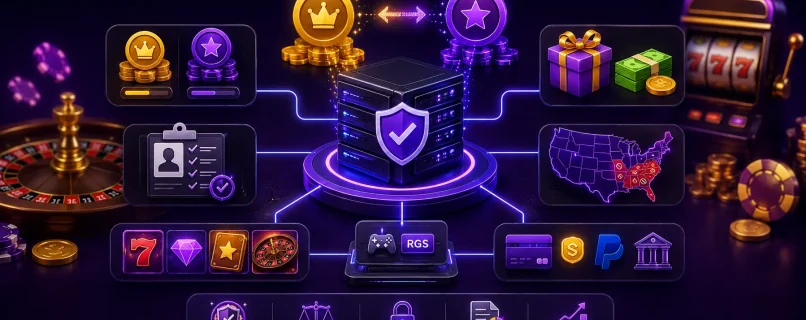
Sweepstakes casinos operate under a legal model that bypasses US gambling laws, but the technical build is as complex as a real-money platform. That gap between legal simplicity and technical depth is where most operators underestimate the project, and where poorly scoped builds run into costly delays.
This guide is written for operators, product owners, and investors evaluating sweepstakes casino software solutions. It covers the legal framework, the architecture decisions, the features you cannot ship without, realistic cost ranges, and what a qualified development partner actually brings to the table.
What this guide covers:
- How the sweepstakes legal model works and why it holds up under US law
- The core technical differences between sweepstakes and real-money casino development
- Required platform features: redemption engine, KYC-lite, geo-blocking, and RGS integration
- Certification considerations and compliance design
- Development cost ranges and the factors that drive them
- How Whimsy Games builds sweepstakes casino platforms, with real project examples
The Sweepstakes Legal Model: How It Actually Works
The sweepstakes casino model is built on a legal framework that has existed in US consumer promotions law for decades. It does not exploit a loophole. It applies a well-established legal structure to a digital casino context, and understanding that distinction matters before a single line of code is written.
The foundation is the no-purchase-necessary rule. Under US federal and state sweepstakes law, a promotion cannot require payment to participate. This separates it from gambling, which requires three elements: consideration (payment), chance, and prize. By removing the payment requirement, sweepstakes casinos eliminate the “consideration” element and operate legally across most US states without a gambling licence.
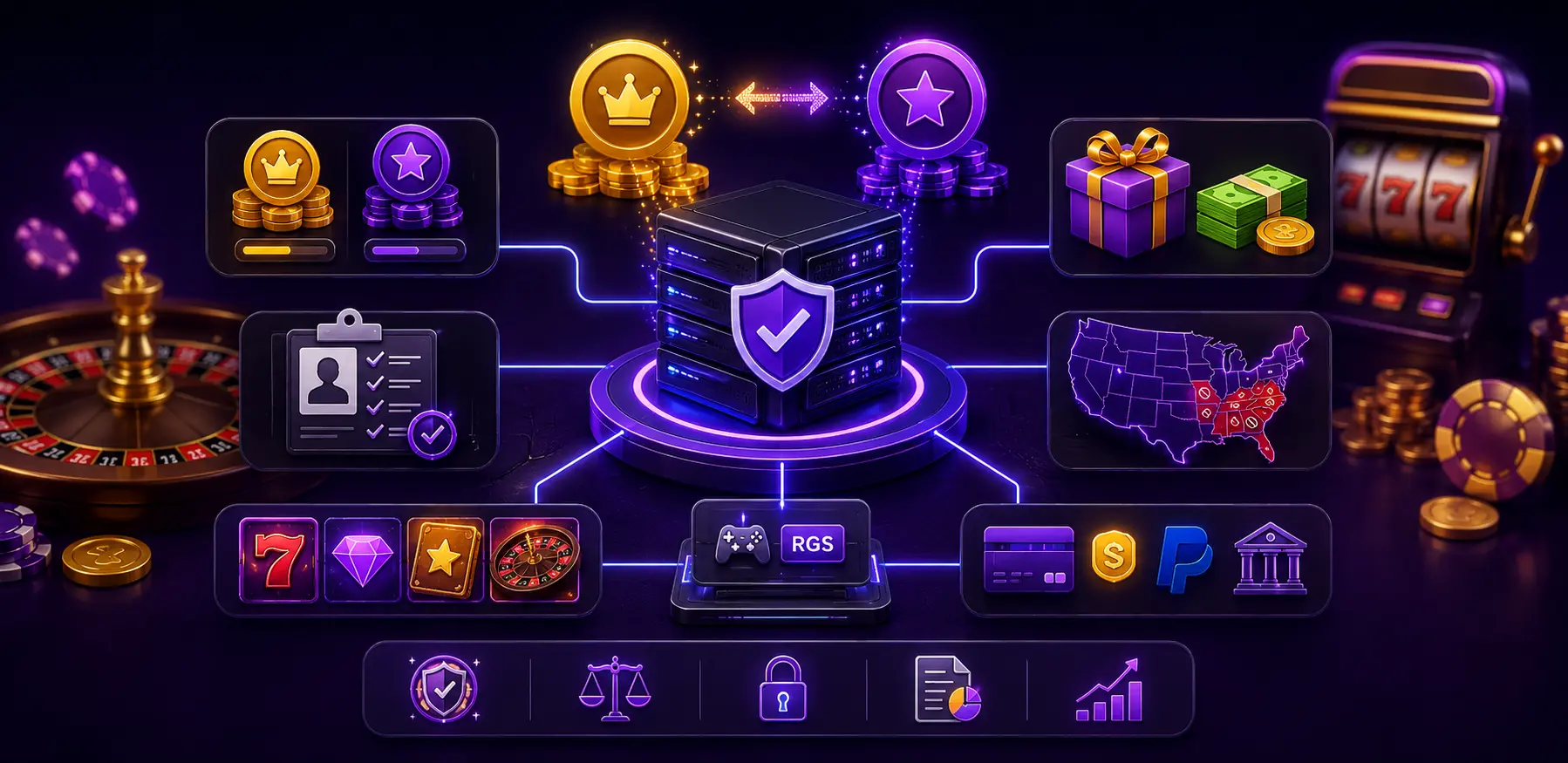
The Dual-Currency System
Every compliant sweepstakes casino runs on two parallel currencies:
| Currency | Purchase Required? | Redeemable for Cash? | Primary Use |
| Gold Coins (GC) | Optional (can be purchased or received free) | No | Casual gameplay, no cash value |
| Sweeps Coins (SC) | Never (free entry only) | Yes, via prize redemption | Sweepstakes gameplay with prize eligibility |
Players can purchase Gold Coins as a convenience item. They receive Sweeps Coins as a free bonus alongside those purchases, through daily login rewards, or by requesting them via post. That postal route is not optional marketing. It is the mandatory alternative method of entry (AMOE) that makes the entire model legally sound. Sweeps Coins can then be redeemed for real prizes, typically cash or gift cards, once a minimum threshold is reached.
The real implication for operators: this is not a simplified payment model. It is a parallel economic system that must be engineered with the same rigour as a real-money wallet. The redemption engine, currency ledger, and free-entry mechanism all need to function correctly under legal scrutiny.
State-Level Restrictions
Not all US states permit sweepstakes casinos. Washington, Idaho, Nevada, and Michigan have historically restricted or prohibited the model. A compliant platform must implement geo-blocking that prevents residents of restricted states from accessing Sweeps Coin gameplay, while potentially still allowing Gold Coin play. This is a technical requirement enforced at the platform layer, not a terms-and-conditions footnote.
Sweepstakes vs Real-Money Casino Development: The Technical Differences
Operators who have built real-money platforms often assume a sweepstakes build is a lighter version of the same thing. It is not. The two models share a surface-level resemblance — slot games, a lobby, user accounts — but diverge significantly at the architecture level.
What Stays the Same
Both platforms require the same core game engineering. RNG systems, math models, RTP calibration, symbol animation, bonus mechanics, and cross-platform rendering are identical in complexity. A slot game built for a sweepstakes casino needs the same production quality as one built for a regulated real-money operator. Players have the same expectations regardless of whether they paid for their credits or received them free.
As Denys Kliuch, CEO of Whimsy Games, explains in the studio’s cost guide: “The biggest misconception is that slot development cost is driven only by features. In reality, visual production and polish often define up to 50% of the total budget, especially in competitive casino markets.”
That applies equally to sweepstakes content. The game layer does not get simplified because the legal model is different.
What Changes Fundamentally
The differences are concentrated in the platform layer:
| Component | Real-Money Casino | Sweepstakes Casino |
| Currency system | Single fiat wallet | Dual-currency ledger (GC + SC) |
| Payment processing | Licensed payment gateway | Coin package purchases (not gambling) |
| KYC requirements | Full AML/KYC identity verification | KYC-lite: age verification + fraud screening |
| Redemption | Withdrawal to bank/e-wallet | Prize redemption engine with threshold logic |
| Regulatory licence | Required per jurisdiction | Not required (sweepstakes law) |
| Geo-blocking | Licence-based territory restriction | State-level sweepstakes restriction |
| Free entry | Not applicable | Mandatory AMOE (postal request system) |
| Certification | GLI/iTech Labs game certification | Optional but strongly recommended |
The Redemption Engine: The Most Underestimated Component
In a real-money casino, withdrawals are handled by a payment processor. In a sweepstakes casino, the redemption engine is a bespoke system with no off-the-shelf equivalent. It must:
- Track Sweeps Coin balances separately from Gold Coins at all times
- Enforce minimum redemption thresholds before processing any prize claim
- Validate player eligibility, including identity checks at the point of redemption
- Connect to prize fulfilment (PayPal, bank transfer, gift cards)
- Maintain an auditable record of every redemption event for compliance purposes
This is not a payment integration. It is a core platform component, and it is the one most likely to cause compliance issues if built without experience in the sweepstakes model. Operators who treat it as an afterthought typically discover the problem during their first payment processor review.
Required Platform Features: What You Cannot Ship Without
A sweepstakes casino platform has a non-negotiable feature set. These are not nice-to-haves. They are the components that determine whether the platform is legally operable and commercially viable from day one.
Dual-Currency Wallet and Ledger
The wallet system must maintain two completely separate balance ledgers in real time. Every transaction — purchase, bonus credit, gameplay, win, redemption request — must be logged against the correct currency with a full audit trail. The ledger cannot allow Gold Coins and Sweeps Coins to be commingled, and the system must be capable of producing per-player transaction histories on demand.
This is architecturally more complex than a single-currency wallet. It requires:
- Separate balance tables with transaction-level logging
- Currency-specific rules engine for bonuses and promotions
- Admin back-office tooling for balance adjustments and dispute resolution
- API endpoints that expose currency state to the game layer in real time
Geo-Blocking at the Platform Layer
Geo-blocking cannot be handled only at the front end. A compliant sweepstakes platform enforces geographic restrictions server-side, combining IP geolocation with user-declared state at registration. The system must block Sweeps Coin access for players in restricted states, log the geo-check result at login and at every SC transaction, and handle VPN detection to prevent circumvention.
Critical detail: Gold Coin gameplay may still be permitted in restricted states, as it carries no cash value. The geo-blocking logic must be granular enough to distinguish between currency modes, not simply block the entire platform.
Alternative Method of Entry (AMOE)
Every sweepstakes promotion must offer a free method of entry that does not require purchase. For a casino platform, this typically means a postal request system: players write in to receive Sweeps Coins at no cost. The platform must provide a published AMOE address and process, credit the appropriate SC amount to the player’s account, and log AMOE credits separately for compliance reporting.
This is often treated as an afterthought in early builds. It should not be. Regulators and legal counsel will review the AMOE process as part of any compliance assessment, and payment processors increasingly ask for documentation of it.
RGS Integration
A Remote Gaming Server (RGS) is the backend infrastructure that manages game sessions, communicates with the game client, and records all gameplay outcomes. For a sweepstakes casino, RGS integration serves two purposes: it enables the platform to run third-party game content from providers, and it provides the data layer needed for auditing and reporting.
RGS connectivity must feed correctly into the dual-currency ledger, ensuring that every gameplay event is captured at the server level — not just client-side. This is where game session data becomes compliance data.
Bonus Engine and Promotion System
Sweepstakes casinos rely heavily on promotional mechanics to drive Sweeps Coin distribution: daily login bonuses, purchase-linked SC rewards, tournaments, and seasonal events. The bonus engine must distribute SC and GC independently according to promotion rules, enforce per-player limits and eligibility criteria, and support time-limited campaigns with automatic start and end logic.
This is where the conversion from casual player to engaged player happens. Whimsy Games’ sweepstakes casino software service covers this as a first-class feature — not a bolt-on — because retention in a sweepstakes context depends almost entirely on how well the promotional engine is designed and operated.
Player Dashboard and Transparency UI
Players must be able to see their GC and SC balances clearly at all times, review their transaction history, understand redemption requirements, and access the AMOE process. The UI layer is not just a UX concern — it is a compliance requirement. Obscuring balance information or making redemption terms difficult to find creates legal exposure.
Game Content: What a Sweepstakes Library Needs
The game library is where operators often make their first major strategic error: launching with too few titles, or with content that does not meet the visual and mechanical standards players expect.
A sweepstakes casino competes for attention against other sweepstakes platforms and free-to-play social casino apps. The games must be good enough to hold players who have no financial stake in continuing. That is a harder retention problem than real-money gambling, where the investment itself creates engagement.
Game Types That Perform in Sweepstakes Casinos
Based on Whimsy Games’ social casino and sweepstakes development experience, the content mix that drives retention includes:
- Slot games with distinct themes, Hold and Spin mechanics, and animated bonus rounds
- Instant win and scratch card games that deliver fast-cycle engagement with low cognitive load
- Branded and themed slots that create emotional connection with specific player segments
- Bingo and keno for players who prefer social or slower-paced formats
- Crash-style games for a younger demographic seeking skill-adjacent gameplay
Visual Production Standards: Why They Matter More Than in Real-Money
In a real-money casino, players tolerate mediocre visuals because the financial stakes keep them engaged. In a sweepstakes casino, visual quality is a primary retention lever. There is no equivalent financial hook.
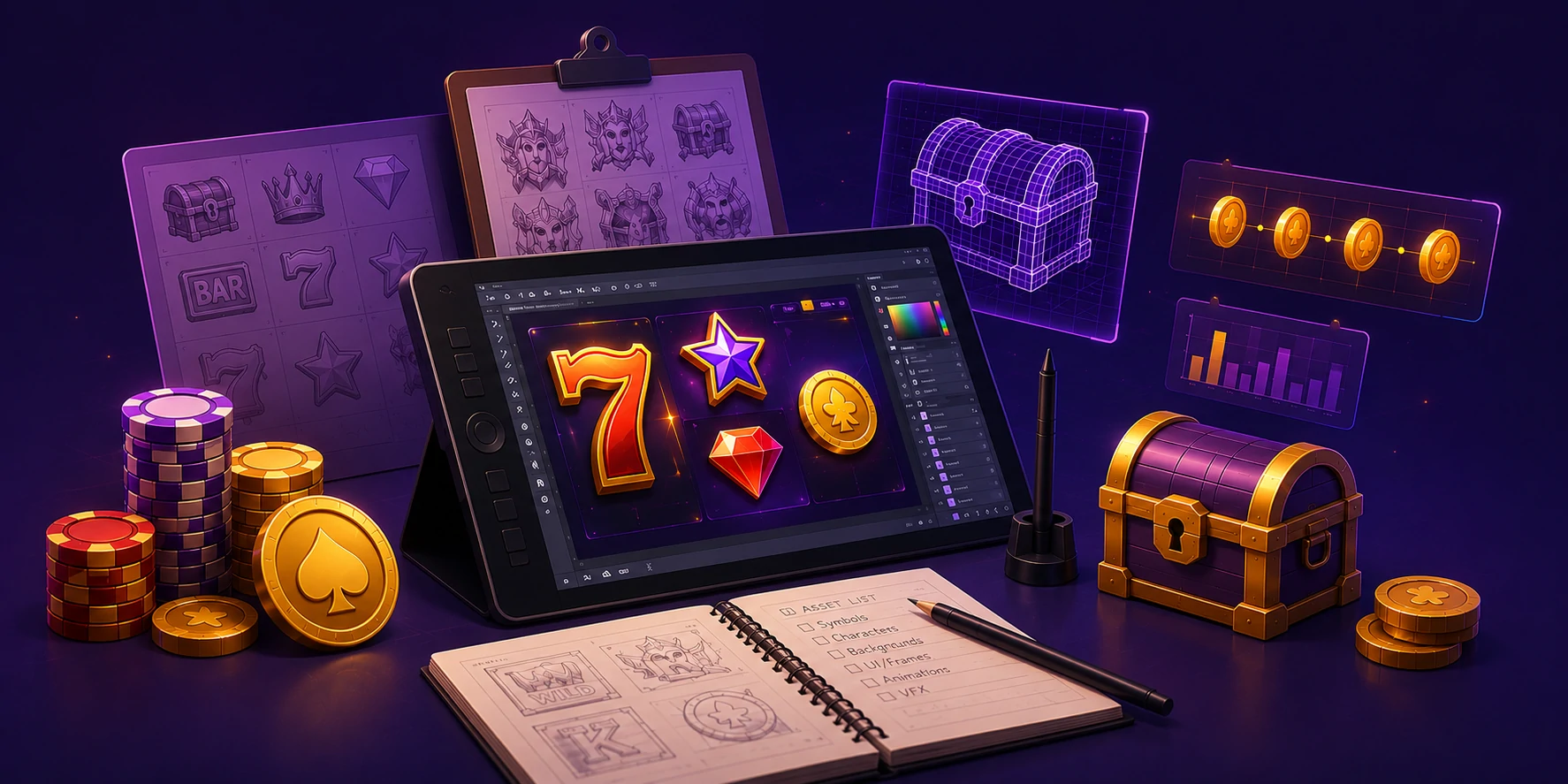
Whimsy Games’ Scratch Card Lottery case study illustrates the visual production discipline a sweepstakes content library demands. The client, a state lottery based in Denmark, needed traditional scratch cards transformed into a modern digital format: visually appealing, animation-rich, and compliant with state lottery requirements. The challenge was volume and consistency — a large number of unique card designs, each with its own animations, win-state VFX, and scratch-reveal mechanics, all delivered within a strict budget and compressed timeline.
The Whimsy Games team (comprising an Art Director, 2D Artist, UI/UX Designer, Animator, VFX Artist, and Project Manager) delivered:
- Multiple card concepts with unique visual identities and thematic layouts
- Polished 2D illustrations for scratch cards, background elements, and win indicators
- Responsive scratch mechanics simulating the tactile feel of a physical lottery ticket
- VFX including coin bursts, sparkle effects, glowing win indicators, and animated reveal highlights
- Idle animations, micro-motion highlights, and celebratory sequences for interaction states
The outcome, as documented in the case study: a scalable visual library that the client could extend with additional card sets post-launch, delivered without compromising quality or visual impact despite the budget and timeline constraints. That production efficiency is what a sweepstakes casino operator needs when building a content library under commercial pressure.
Third-Party Content vs Custom Development
Operators can populate their sweepstakes library in two ways:
- Third-party content via RGS aggregators: faster to market, lower upfront cost, but limited differentiation and ongoing revenue share
- Custom-developed content: higher upfront investment, full IP ownership, no revenue share, and the ability to build exclusive mechanics that competitors cannot replicate
Most successful sweepstakes casinos use a hybrid: third-party content for volume at launch, custom titles for differentiation and brand identity. Whimsy Games supports both paths, building original sweepstakes game content and integrating it alongside aggregated third-party titles through RGS connectivity.
Key insight: A sweepstakes casino that launches with visually weak content will struggle to retain players regardless of how well the platform backend is engineered. Content quality and platform quality must be planned together from the start.
Certification Considerations for Sweepstakes Casinos
Sweepstakes casinos do not require a gambling licence. That is one of their primary commercial advantages. However, the absence of a licence requirement does not mean certification is irrelevant. Operators who skip it often pay a higher price later.
Why Certification Still Matters
Payment processors are the first gatekeepers. Many card networks and payment facilitators are cautious about iGaming-adjacent products. Demonstrating that your platform has been independently tested — that the RNG is certified, the math models are verified, and the platform does not constitute illegal gambling — significantly improves your ability to secure and maintain payment processing relationships.
App store distribution requires it. Apple’s App Store and Google Play have specific policies around sweepstakes gaming applications. Certification of the RNG and a clear demonstration of the no-purchase-necessary mechanism are typically required for app approval. Platforms that have not addressed this during development often find themselves unable to launch native mobile apps.
Investor and partner due diligence. As sweepstakes casinos attract serious capital, institutional investors and strategic partners increasingly expect to see third-party validation of the platform’s legal structure and technical integrity.
What Certification Covers
For sweepstakes casino platforms, the relevant certification areas include:
| Area | What It Covers | Labs Involved |
| RNG certification | Independent verification that game outcomes are genuinely random | GLI, iTech Labs, BMM |
| Game math verification | Confirmation that RTP and volatility match declared parameters | GLI, iTech Labs |
| Platform compliance review | Legal assessment of sweepstakes structure, AMOE, and T&Cs | Legal counsel + labs |
| Security audit | Penetration testing and data protection review | Specialist security firms |
Whimsy Games works with certification partners and testing labs to support clients through this process. According to the studio’s FAQ: “We work with partners and labs so games can pass certification (GLI, iTech Labs, etc.). We follow rules to match market needs.” Games developed by the studio are built to meet the technical requirements of RNG certification from the outset — not retrofitted after development.
Compliance by Design, Not by Retrofit
The most expensive certification outcomes occur when a platform is built without compliance in mind and then audited. Remediation — fixing RNG implementation, restructuring the currency ledger, or rebuilding the AMOE flow — can cost more than getting it right during initial development.
Whimsy Games builds sweepstakes casino platforms with compliance requirements integrated from the concept phase: currency architecture designed for auditability, game math documented and verifiable, and the AMOE process built as a first-class feature rather than a legal footnote. This is the same approach the studio applies to regulated market compliance across its iGaming projects.
Sweepstakes Casino Development Costs: What to Budget in 2026
Cost estimates for sweepstakes casino development vary widely, often because vendors quote for different scopes. The figures below reflect full-platform builds (including platform backend, game content, and integration work), not just the front-end lobby.
Cost Ranges by Scope
Based on Whimsy Games’ service tiers and the 2026 casino game development cost benchmarks published by the studio, sweepstakes casino projects fall into three broad categories:
| Build Scope | What Is Included | Estimated Budget | Typical Timeline |
| White-label / rapid entry | Pre-built platform, basic customisation, limited game content | $50,000 – $100,000 | 3–4 months |
| Mid-range custom build | Custom platform, dual-currency wallet, game library, RGS integration | $100,000 – $200,000 | 4–6 months |
| Full custom platform | Bespoke backend, full game library, bonus engine, analytics, app builds | $200,000 – $500,000+ | 6–10 months |
These ranges align with Whimsy Games’ own budget brackets, which start at $50K-$100K for foundational builds and scale to $500K+ for premium, multi-platform deployments.
The Biggest Cost Drivers
Understanding where budget goes is as important as knowing the total. In sweepstakes casino development, the primary cost drivers are:
1. The redemption engine and dual-currency backend. This is bespoke infrastructure with no off-the-shelf equivalent. Custom development of the currency ledger, redemption workflow, and back-office tooling typically represents a significant portion of the total platform budget.
2. Game content volume and quality. As CEO Denys Kliuch has noted, visual production and polish can account for up to 50% of the total development budget in competitive casino markets. A sweepstakes library needs enough titles to present a credible offering at launch. Whimsy Games’ own slot cost data shows mid-range titles at $30,000-$80,000 each, and advanced titles at $80,000-$150,000.
3. Cross-platform deployment. Web, iOS, and Android each require optimisation work. Mobile-first sweepstakes platforms, which represent the majority of player sessions, require additional investment in responsive UI and native app builds.
4. Third-party integrations. Payment processing for Gold Coin purchases, KYC provider integration, RGS connectivity, and geo-blocking services each carry integration costs and ongoing fees.
White-Label vs Custom: The Strategic Trade-Off
White-label sweepstakes platforms offer faster time to market and lower upfront cost. The trade-offs are real: limited ability to differentiate, dependency on a third-party platform roadmap, and revenue share arrangements that reduce long-term margins.
Custom builds take longer and cost more at the outset, but the operator owns the platform, controls the product roadmap, and retains full revenue. For operators planning a serious long-term sweepstakes business, the economics of custom development typically become favourable within 18–24 months of launch.
Whimsy Games offers both paths. The studio’s three engagement models give operators the flexibility to match the delivery structure to their internal capabilities and budget:
- Project-based delivery: full-cycle development from concept to launch, managed by Whimsy Games
- Dedicated team: a Whimsy Games team integrates directly into the client’s workflow
- Outstaffing: individual senior specialists (slot developers, math designers, WebGL engineers, QA leads) embedded into the client’s team on a flexible basis
How Whimsy Games Delivers Sweepstakes Casino Projects
Whimsy Games is a game development company with over eight years of iGaming experience, a team of 75 professionals, and 116 clients across operators, platforms, and aggregators worldwide. The studio’s sweepstakes casino work spans the full development lifecycle: platform architecture, game content production, post-launch LiveOps, and ongoing support.
The NeoStakes Build: A Full Sweepstakes Platform
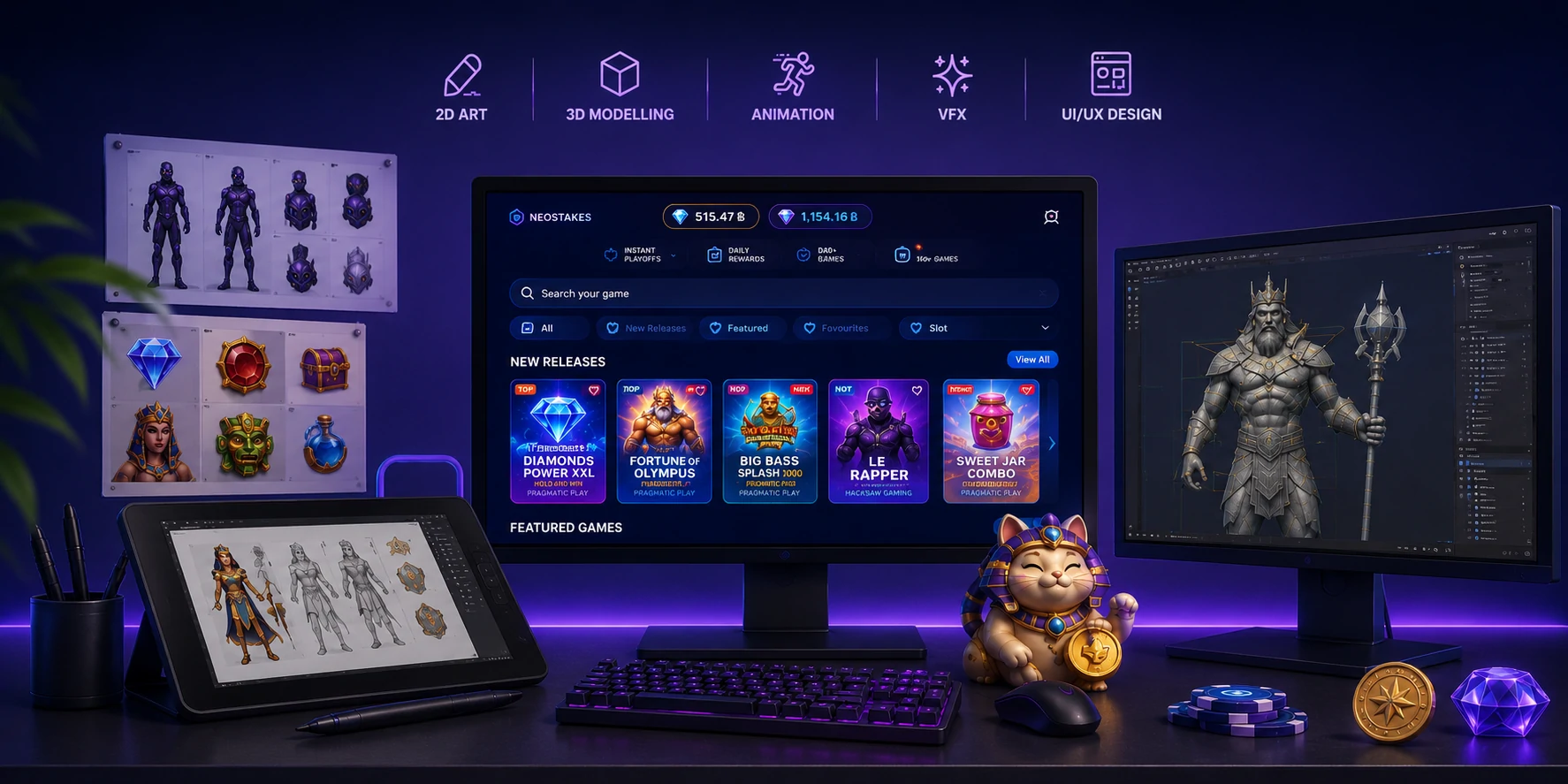
The NeoStakes project is a direct example of Whimsy Games’ sweepstakes casino scope. The studio designed and built a complete sweepstakes casino product: cross-platform UI across web and mobile, a player rewards and dashboard system, a curated game library spanning multiple genres, and the visual identity and branding required to present a sweepstakes platform credibly to a US audience.
What the NeoStakes build demonstrates is scope: this is a full-product engagement, not a game-only commission. The platform covers cross-device compatibility, a structured rewards system, and a game library built specifically for the sweepstakes context. These are the same features any operator evaluating sweepstakes casino software solutions needs to plan for from day one.
What LiveOps Delivers: Royal Slots
The Royal Slots case study demonstrates what structured LiveOps and data-driven development deliver in a social casino context — and the same operational discipline applies directly to sweepstakes casino platforms.
Royal Slots is a mobile casual casino game built for a Cyprus-based client. The project involved full-cycle development: game design, 3D art, animation, UI/UX, VFX, and LiveOps integration. An 18-person team delivered:
- Interactive slot machines with stunning visuals and animations
- Rewarding bonus features including multipliers and special reward mechanics
- LiveOps integration for regular in-game events and content updates
- A/B testing and analytics integration to optimise game mechanics post-launch
The outcomes, verified in the published case study:
- 100,000 active users acquired in the first three months
- 85% retention rate after 30 days of gameplay
- 94% positive reviews from players praising visuals and immersive gameplay
Retention at that level does not happen by accident. It is the product of well-designed LiveOps, data-driven iteration, and a game that was built with player engagement as a first-order concern — not an afterthought.
The 8-Stage Development Process
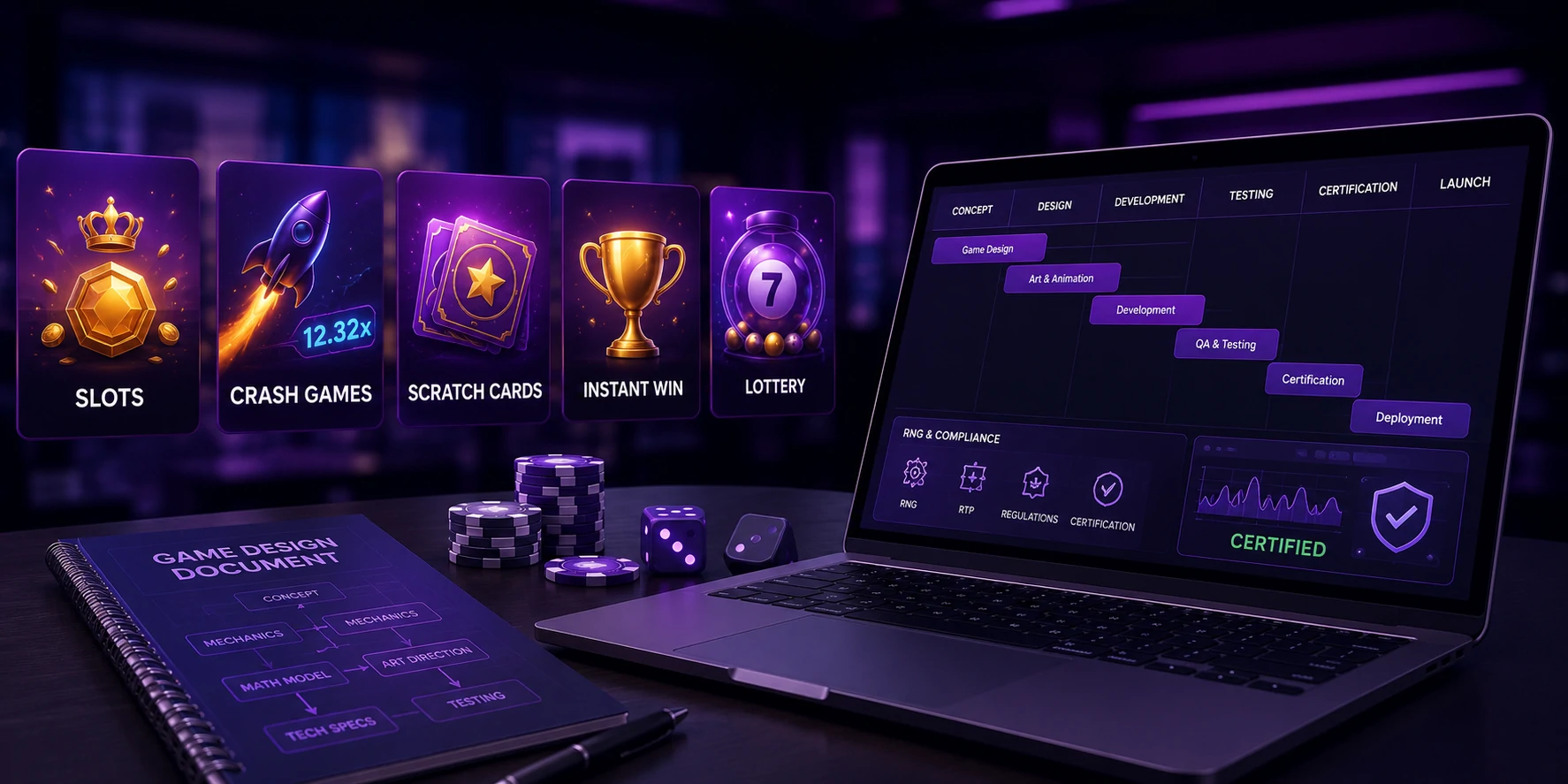
Whimsy Games follows a structured eight-stage process for sweepstakes casino projects, as outlined on the studio’s sweepstakes casino software service page:
- Consultation and ideation: scope definition, target market analysis, legal structure review
- Concept development: platform architecture, game content plan, compliance design
- Design and prototyping: UI/UX wireframes, game concept art, interactive prototypes
- Development: backend, game engineering, RGS integration, dual-currency wallet
- Testing and QA: functional, performance, device compatibility, and security testing
- Deployment: launch with full technical support
- Post-launch support: monitoring, bug resolution, platform updates
- Optimisation: A/B testing, LiveOps events, analytics-driven iteration
Post-launch is not an afterthought. The studio provides ongoing maintenance, performance reviews, and content updates — the infrastructure that keeps player engagement compounding rather than declining after launch.
Operators who want to discuss scope, timeline, and cost for a sweepstakes casino build can contact the Whimsy Games team directly. The studio provides custom quotes based on project requirements — no generic pricing, no fluff.